The First Emirati in Space: Hazzaa Al Mansoori on Exploration and Inspiration
By: Adnan Razi Khan Published Dec 22, 2025
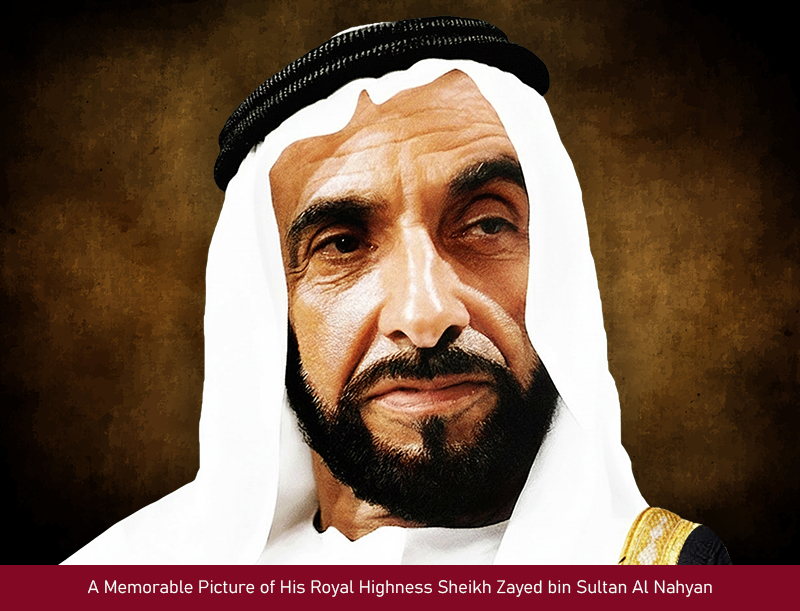
December 2, 1971, marked the birth of a new Muslim nation, the United Arab Emirates, appearing on the face of the Earth with hope, unity, and vision. From its very first day, the UAE carried the dream of progress under the wise and inspiring leadership of its Founding Father, Sheikh Zayed bin Sultan Al Nahyan, whose vision transformed a desert land into a beacon of development, prosperity, and ambition.
The UAE’s development journey is a remarkable story of resilience and transformation. From uniting the seven emirates into one strong federation, Sheikh Zayed and his fellow leaders guided the country through its formative years by investing in infrastructure, education, and human development. The discovery of oil played a role, but it was the wisdom of leadership, the commitment to unity, and the courage to dream beyond immediate needs that turned the UAE into one of the most dynamic nations in the world.
Key projects in transport, aviation, renewable energy, and sustainable development further solidified the UAE’s global standing. Yet what makes the country truly stand out is its forward-looking vision in technology and Artificial Intelligence (AI), ensuring it remains at the cutting edge of progress. The launch of the UAE National AI Strategy 2031, the appointment of the world’s first Minister of Artificial Intelligence, and Dubai’s transformation into a global AI-driven smart city are milestones that reflect the nation’s ambition to lead in the Fourth Industrial Revolution.
Among the most significant areas of advancement has been space exploration. Inspired by the vision of its leadership under the guidance of His Highness Sheikh Mohammed bin Zayed Al Nahyan, President of the UAE, and His Highness Sheikh Mohammed bin Rashid Al Maktoum, Vice President, Prime Minister, and Ruler of Dubai the nation has emerged as a pioneer in the Arab and Muslim world in space science and technology. Their belief that “the impossible is possible” sparked bold projects, from the historic Hope Probe mission to Mars, which made the UAE the first Arab nation to reach the Red Planet, to the human spaceflight program that placed Emirati astronauts aboard the International Space Station.
At the heart of these achievements is the Mohammed Bin Rashid Space Centre (MBRSC), the nucleus of the UAE’s space ambitions. It not only drives exploration but also inspires young generations, proving that the UAE’s vision extends far beyond Earth, toward the stars.
Today, the UAE is recognized not only for its economic strength and architectural marvels but also for its boldness in embracing science, technology, AI, and space exploration. Its leadership has turned a young nation into a model of inspiration, admired around the globe. The UAE has shown that with vision, determination, and unity, even the most ambitious dreams can be realized.
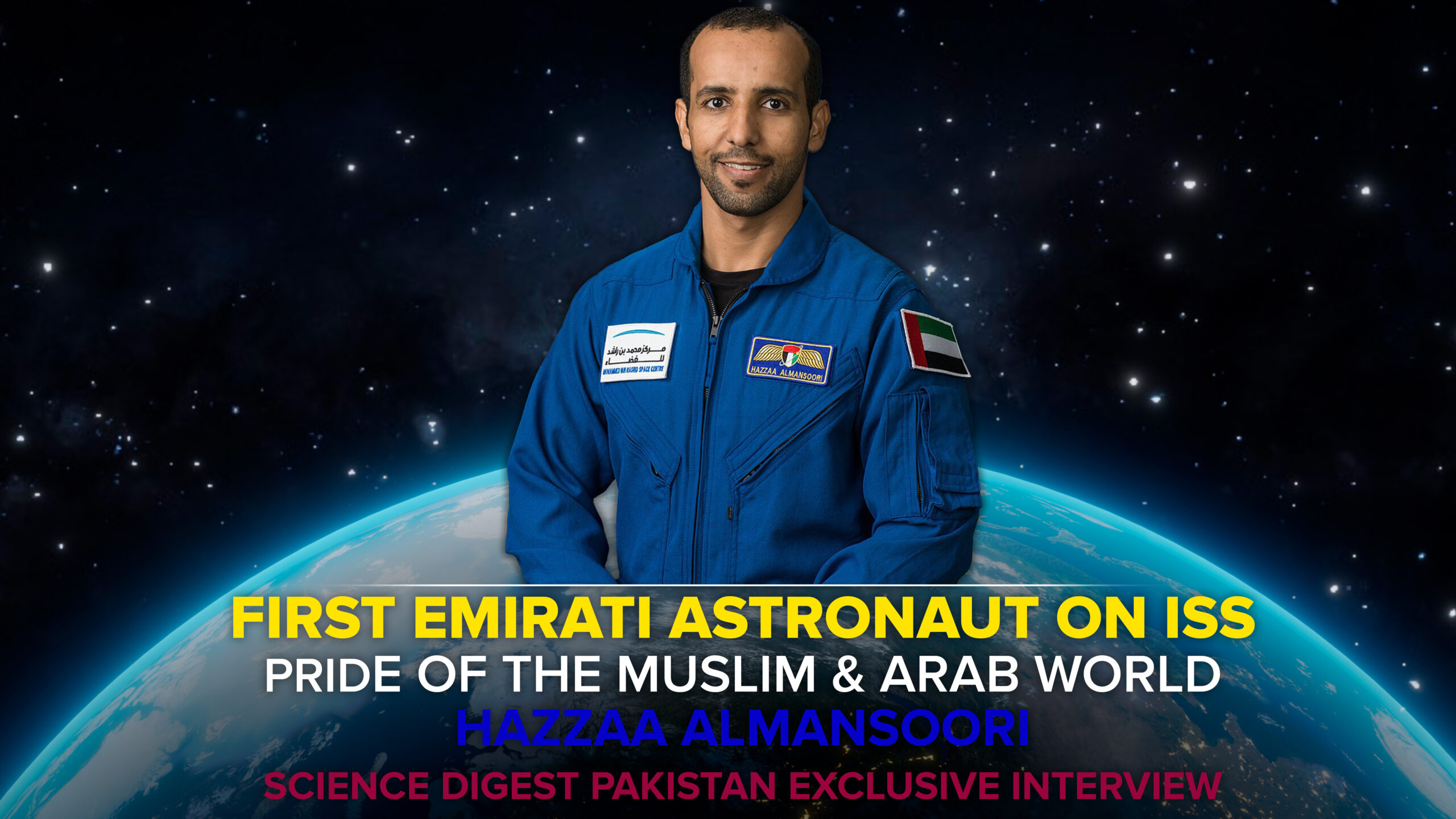
With this extraordinary journey of the United Arab Emirates in mind, we now turn to the story of Hazzaa AlMansoori, the first Emirati astronaut to reach the International Space Station (ISS) and a symbol of the nation’s vision to explore new frontiers.
interview with Hazzaa AlMansoori, beginning with the below first question:
What was the key moment that made you decide you wanted to go to space?
Hazzaa: So, when you’re talking about space, it is something that has impacted us since our childhood. I’m talking about my childhood, and when I was a kid, I remember that my ancestors, when we were traveling, used stars to navigate. These are the stories that we heard from our parents when we were gathering at the fire camp and talking about ancestors, and how they used the stars for traveling. I looked at the stars at that moment and remembered that my ancestors used stars to travel. They used them to know the seasons. So, I wanted to go to space. I wanted to be that guy exploring space.
When I was a kid, I remember I saw a lot of pictures of astronauts and cosmonauts traveling to space, starting from Yuri Gagarin, the first human in space, and also Neil Armstrong landing on the moon. All of these pictures and stories instilled in me the passion that I wanted to be an astronaut when I grew up.
How did you first learn about the UAE Astronaut Program, and what made you confident you could be part of it?
Hazzaa: Well, as I grew up, to be honest, I realized it’s difficult to be an astronaut in our region, especially in the UAE, because at that moment, when I just graduated from high school, I realized there was no path to be an astronaut. There was no astronaut program.
At that time, I joined the Air Force, and I became an F-16 pilot. And always, when I was flying at night looking at the stars, I had that dream of going to space. In December 2017, His Highness Sheikh Mohammed Bin Rashid Al Maktoum, in one of his posts on Twitter, announced the UAE Astronaut Program. And it was a big thing.
The announcement was a call for everyone, the youth, boys and girls to apply to be an astronaut. If you see yourself capable and you have the ability to represent the UAE and the whole Arab nation on board the International Space Station, apply without any hesitation.
I applied along with 4,000 applicants. It was tough competition, to be honest, because they were coming from different backgrounds. Before, they were selecting astronauts mostly from aviation backgrounds, because that was one of the biggest skills needed, especially with how fast rockets and equipment are. But these days they are looking for astronauts from different backgrounds, from different skill sets, because each one has his own skills, his own way of solving problems.
So, when you are selecting astronauts, you need to have this group of people coming from different backgrounds. So, it was a very tough selection, because it was the first one for the United Arab Emirates.
What were the primary objectives of your mission aboard Soyuz MS-15?
Hazzaa: So, before we talk about the objective of Soyuz MS-15, I want to talk about the objective of our astronaut program.
As I mentioned, we did the selection. The objective is to inspire the exploration spirit in the young generations. We want to instill in them that going to space is going to open a new frontier for everyone not only for sending humans to space, but also for education, for technology, and for impacting the industry here in the United Arab Emirates.
All of these objectives were the things we worked on from the beginning to make our mission a successful mission for the UAE.
When I was selected, along with my colleague Sultan Al Neyadi, back in 2018, they sent us to Star City, which is a small city outside Moscow. We trained there in the same place where Yuri Gagarin trained and prepared for his mission. There was a lot of history that we witnessed during our training.
The objective of our mission on MS-15 was basically to participate in human spaceflight and to be part of the global exploration efforts to conduct experiments, to conduct science, and to inspire youth. That was the big umbrella of objectives.
There were also many experiments that we conducted during our stay on board the International Space Station.
How did you prepare physically and mentally for the demands of the mission?
Hazzaa: So, we are talking about preparing yourself for going to space. It is really a tough phase. You come with your personal experience and qualifications, but in addition you have to go through different types of preparation.
There is the technical side, there are experiments that you need to conduct on board the station, and there are also things you need to know about fixing if something breaks on board the station.
When we trained for the first mission, I was training in Star City on the mock-up for the Soyuz MS-15. The mock-up is actually a replica of the Soyuz rocket and vehicle, where we practice daily activities, including the launch itself, going to space, the nominal launch, and also off-nominal situations like fire, toxic atmosphere, or loss of pressure inside the vehicle.
That is one part of it. The other part is the experiments that we conducted on board the station. I conducted more than 15 experiments, some during the flight, some after the flight, and some on board the station itself. These were not only with our Russian counterparts, but also with ESA and JAXA. So, it was a variety of experiments conducted on the station.
Another important aspect is the physical preparation. You have to train daily to prepare yourself for launch and for space to know how to deal with weightlessness and microgravity physically, and to be ready for that. One type of training is the parabolic flight, also called the “vomit comet.” It gives you about 30 seconds of weightlessness, which provides a taste of what to expect when you are on the station.
And another thing is learning how to fix things on board the International Space Station. When you are on the station, you are the scientist, the technician, the photographer, the reporter, you are everything. You have to learn all of it.
So, all of these skills are part of the preparation that we went through during training.
Can you explain the importance of the UAE student-designed experiments you conducted on the ISS?
Hazzaa: So, on the International Space Station (ISS), as I mentioned, I conducted more than 15 experiments. One of them that I would like to share is called Int-Ball. It was a collaboration with JAXA, and the experiment was a showcase of how students on the ground could control or program a floating robot on board the station.
Basically, I was on the station with this floating robot. It is a JAXA experiment called Int-Ball, where the robot floats close to the astronauts and can interact with them a little bit.
Students on the ground could interact with Int-Ball, program it, and also control it remotely from Earth. That was something really neat and important to share with students, so they could develop the skill set of controlling things remotely especially when it’s floating in space.
Why was it significant to carry cultural symbols like the UAE flag and Al Ghaf tree seeds to space?
Hazzaa: Definitely, each one of us astronauts and cosmonauts going to space comes from different countries, with different mindsets, different religions, and different ways of thinking.
The beauty of space is that it brings all of us together, despite all these differences. We respect each other and work together in this harsh environment of space. That is really the beautiful part of it.
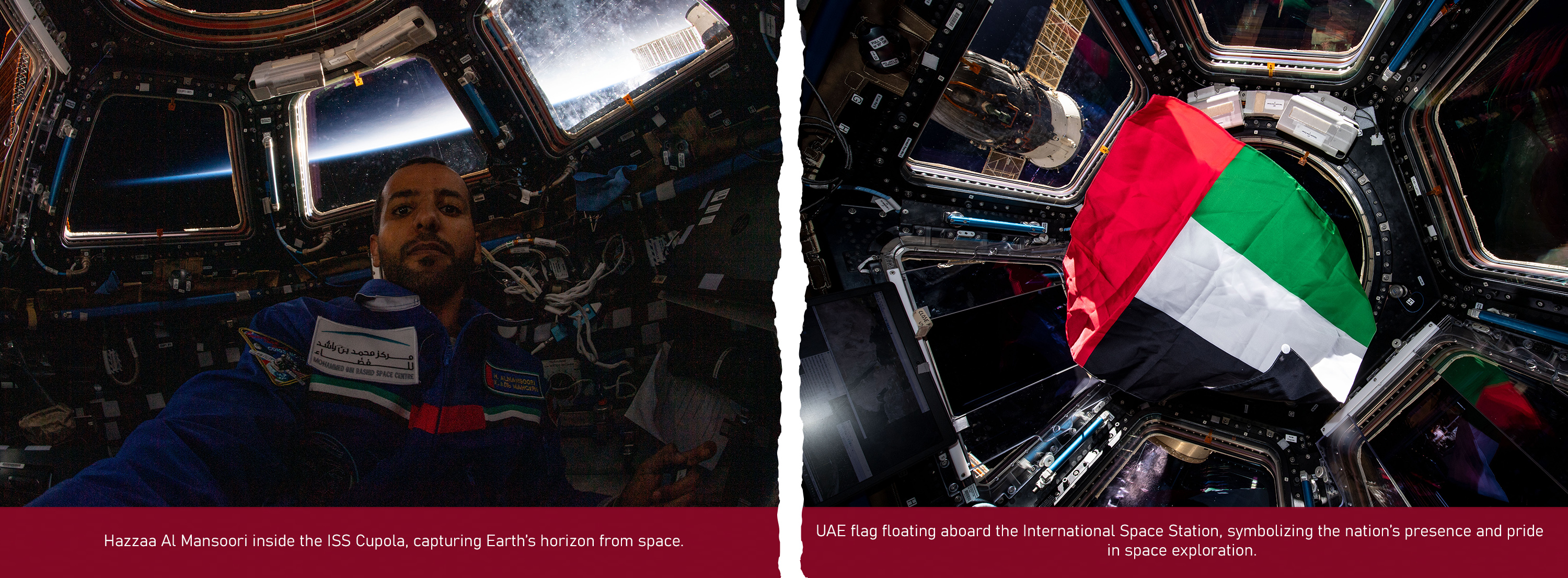
And when we are up there, we are proud of our identity, our heritage, and our background. So, we thought that taking with us something that represents our culture, our religion, and our country is really important.
Because it carries a huge message for the next generation: you can advance in science and in different aspects of life, but you must always go back to your roots and carry them with you wherever you go.
What systems or tasks on the ISS were you most responsible for during your stay?
Hazzaa: So basically, on board the International Space Station, I was working with the Russian segment most of the time, together with my Russian colleagues. I was part of that segment for most of my stay.
Additionally, I also conducted a couple of my experiments inside the ESA module Columbus. For example, one of them was Fluidics, where we studied how fluids interact with weightlessness and the effects of microgravity on them. That was something really huge to handle.
Basically, when we are on board the station, each one of us has his own crew quarters, a small personal area where we keep our belongings and have our own space. At the same time, each astronaut is also in charge of different parts of the station or different emergency roles for example, in case of ammonia leak, fire, or depressurization.
Each one of us must know exactly what to do in such a situation, and how to work together as a team to handle it.
What was your first reaction when entering the ISS for the first time?
Hazzaa: Believe me, it felt like a dream. It felt like I went back in time to that child looking at the stars, wanting to be an astronaut. I was saying in my mind, I made it. I’m in space. I’m floating.
At the beginning, it was really difficult just to navigate because it’s a big space, relatively speaking. You have to control your body and how you orient yourself. At first, it felt like starting to work all over again, but now while floating. I was moving my head everywhere, trying not to touch any sensitive equipment.
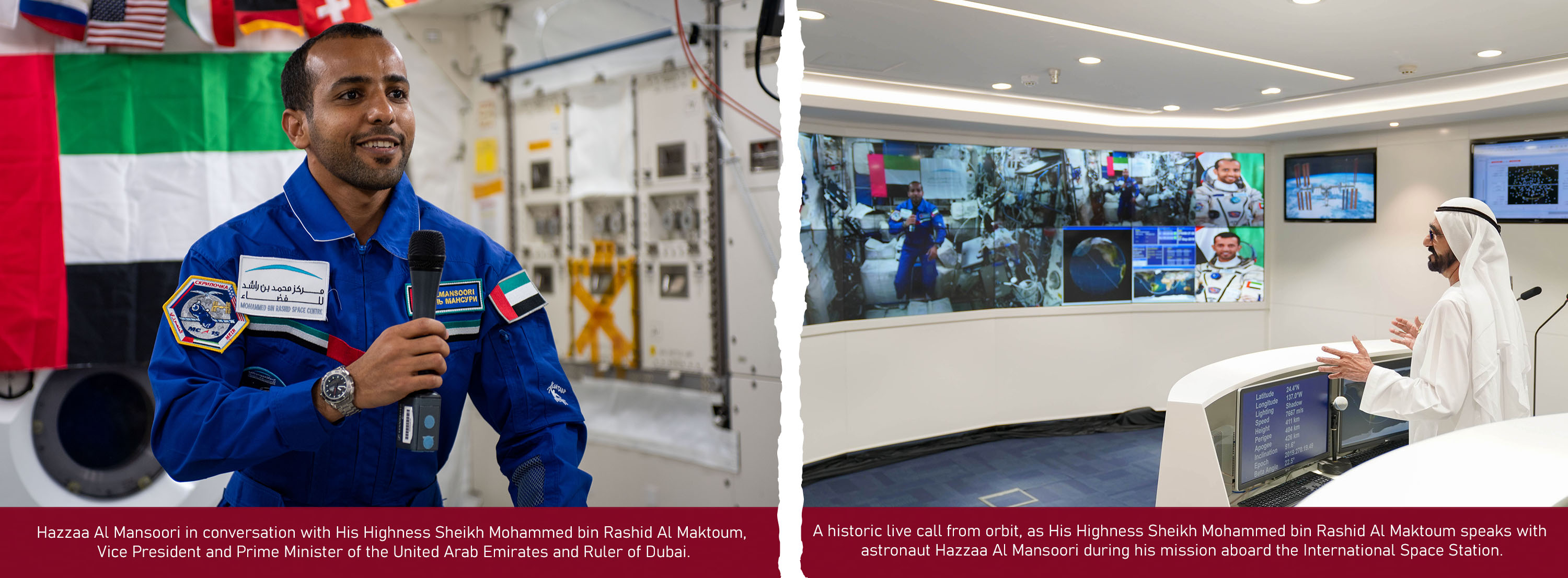
In a way, it was magical because you feel like you are floating, and everything around you is floating as well. We had to make sure that everything was attached or tethered.
It was something I wanted to experience again. It was really a great feeling just to be on board the station with people I had trained with before, now living with them and conducting science. It was truly a moment I will never forget.
How did you feel when you first saw your country from space?
Hazzaa: Yes, so one of the things that all of us astronauts agree on is looking at Earth from space. It’s what we call the overview effect, and it is an overwhelming feeling – feeling fragile, feeling small, floating in space while looking at your planet.
At the beginning, as you mentioned, I was looking for my country, waiting for the pass over the United Arab Emirates, trying to recognize places like my school, or any big features I could identify such as mountains or deserts.
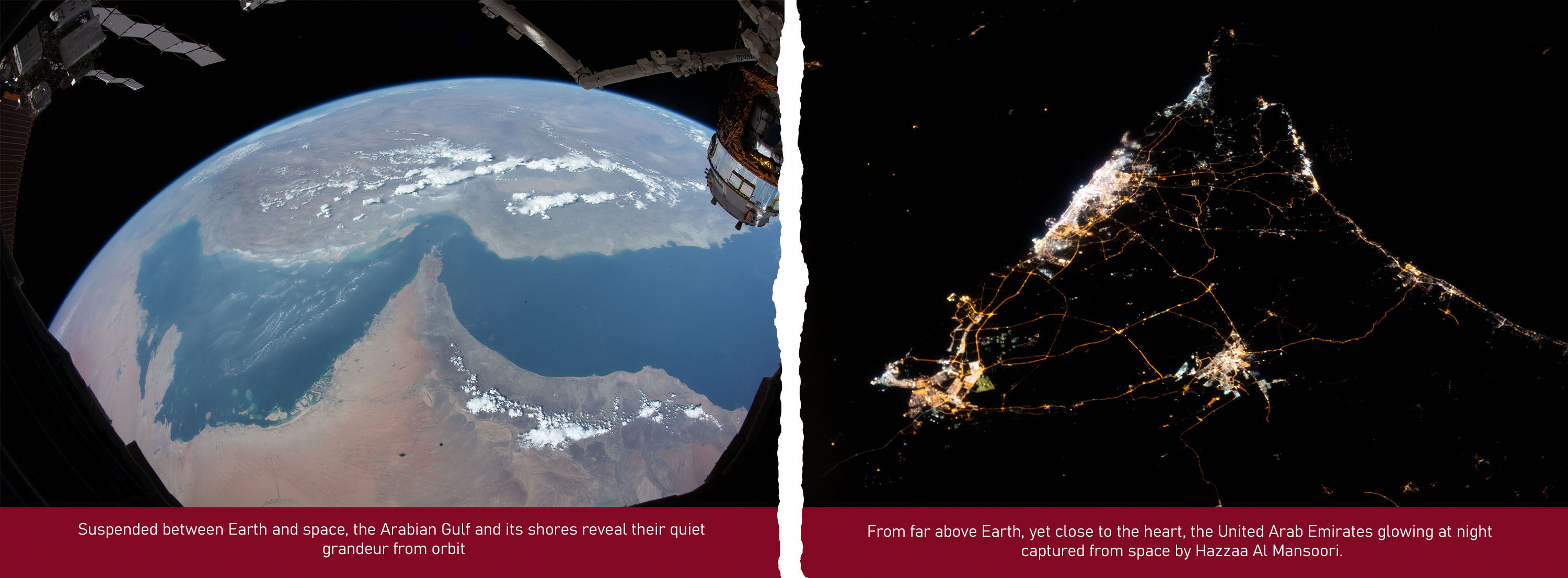
As I kept orbiting Earth and looking at it from 400 kilometers above, I felt that looking at Earth is magnificent, overwhelming, and surreal. It feels like the whole planet is your country. You have this feeling that you want to come back to it, and you remind yourself: I am here only a few people have made it into space. I worked hard. I should represent not only my country or the Arab region, but the whole Earth, all of humanity, on board the station.
Because it is a unique place where we conduct experiments and science, not only to help ourselves up there, but to help people on the ground. All of these thoughts came to my mind when I was looking at Earth.
Of course, looking at my country was something that made me very happy. I took a lot of pictures, day and night, of my beloved country cities like Dubai, Abu Dhabi, and other places. At night they looked so beautiful, so amazing, because you can see different things from above the city lights, the roads. And I shared all of them on my social media accounts.
How did you structure your day aboard the ISS between experiments, maintenance, and personal time?
Hazzaa: So, on board the station, time is very precious. It is important to structure your timeline very carefully.
Basically, the timeline for each one of us is coordinated and planned three weeks in advance. Everything is set: when you wake up, hygiene time, breakfast time, maintenance, experiment time. All of these are scheduled. Each of us has our own laptop and an iPad with the personal schedule. Usually, the night before going to sleep, I would open my schedule and check my timeline.
The International Space Station is orbiting Earth, it is not stationary in space. We make about 16 orbits in one day, so we witness 45 minutes of daytime and 45 minutes of nighttime repeatedly. But our working hours are not based on day and night; we follow London time, Greenwich Mean Time.
So basically, at 6:00 AM GMT, we wake up. There are 30 minutes for hygiene and preparing food for breakfast. At 7:00 AM, we start what they call the daily brief with ground stations, not only NASA’s Johnson Space Center Mission Control, but also JAXA, ESA, and Roscosmos. During this daily brief, we get updates if there are any, and then we start looking at our program for the day.
For example, one day I might have exercise. Physical exercise is mandatory. Every day we have to do about two to two and a half hours of physical training. This helps reduce the impact of being in weightlessness. The exercise sessions are scattered throughout the day for each astronaut, to avoid conflicts over equipment use.
Another part of the timeline is maintenance. We, the astronauts, are the engineers, technicians, and plumbers on the station. If something breaks, we fix it. We also update and maintain equipment when needed.
Then there are the experiments. Usually, when there’s an experiment, the scientist responsible is on the ground, waiting to connect with us. Sometimes, because of time zones, it might be their night or early morning, but they are available when needed. We set up cameras to show our hands and the way we conduct the experiment, so the scientists on the ground can follow in real time. Often, we had trained with that same scientist before the flight, so we already knew each other, and working together during the experiment felt familiar.
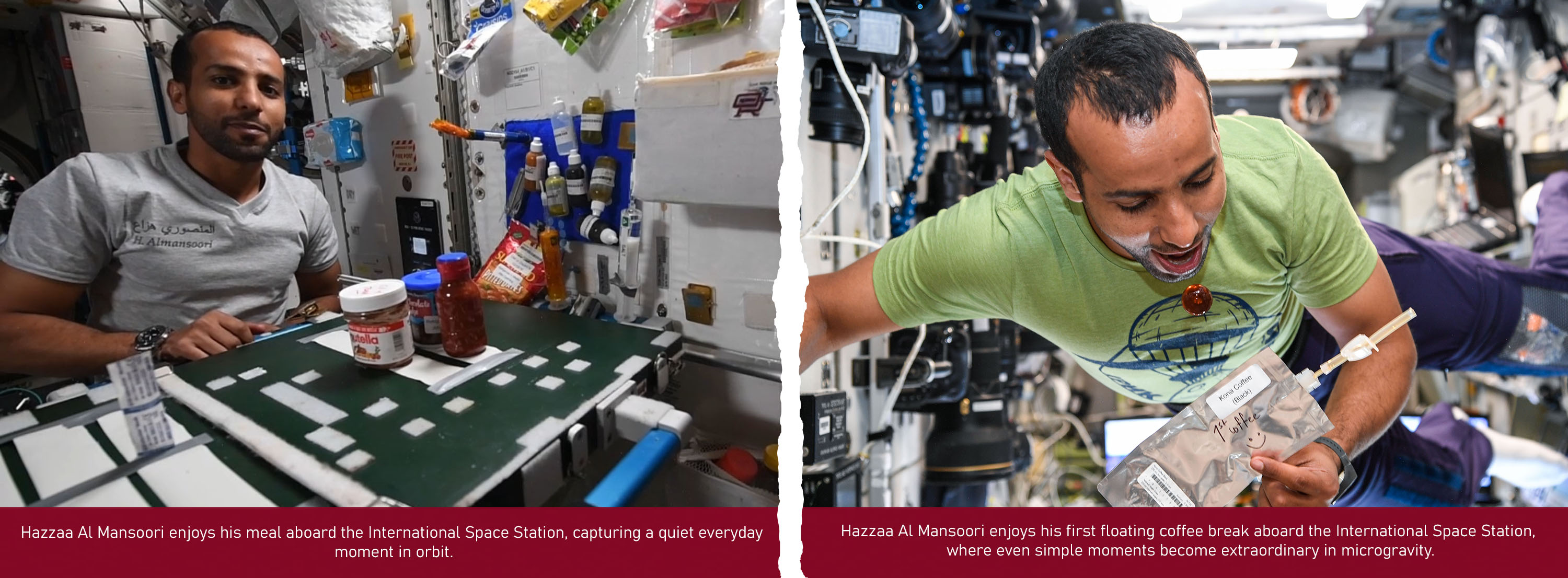
At the end of the day, there is usually some free time. I would often use it to take pictures of Earth through the window facing our planet, the Cupola (A window module facing Earth). Then we gather together in a place called Node 1. It has the galley and a table where we prepare food. We sit together, eat, chat about our day, and often talk about our favorite things back on Earth.
Can you share a memorable moment or challenge you faced in microgravity?
Hazzaa: I think the most memorable thing is floating in space and looking at Earth. The first time I experienced weightlessness was on the way to dock with the station.
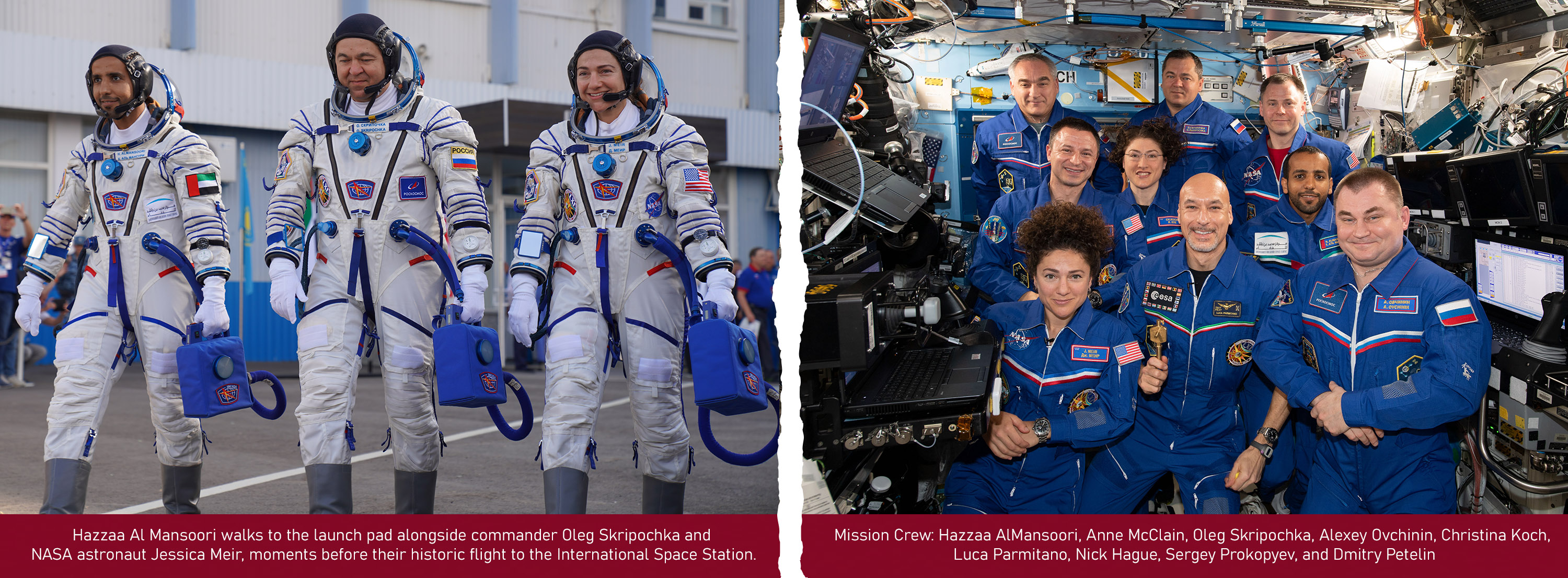
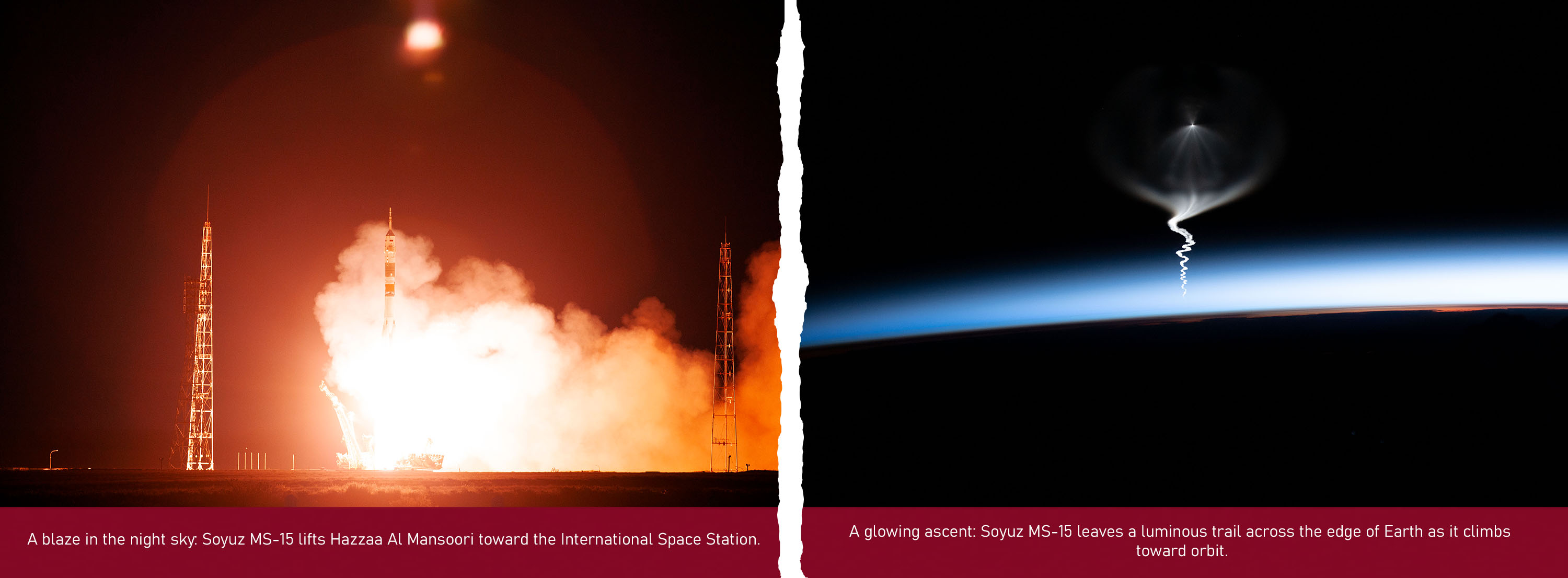
When you launch from Baikonur, the rocket goes from the ground to about 200 kilometers in roughly 9 minutes. At that point, the boosters stop, we reach 200 kilometers, and we experience weightlessness for the first time.
We were still getting further from Earth, and when I looked out of the window on my right, I saw Earth getting smaller and smaller. That was the feeling I wanted to experience again, because it was like a dream come true for me.
I was looking at Earth getting smaller, looking at my colleagues Jessica Meir from NASA, and the commander from Russia Oleg Skripochka. We were happy and excited, experiencing weightlessness, playing with our pens. It was an amazing feeling.
Then we continued our ascent from 200 kilometers to 400 kilometers to reach the Space Station. That is something I will definitely never forget.
How did giving the first Arabic-language guided tour of the ISS feel, and why was it important?
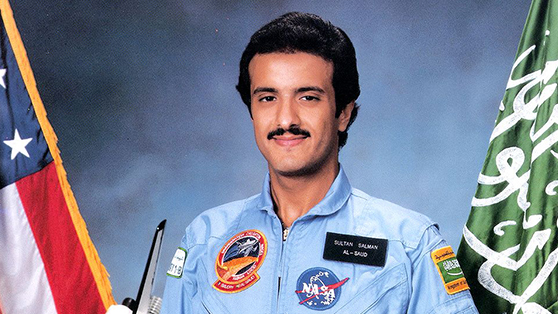
Hazzaa: Arabic language is my mother language. It is the language that I spoke since my childhood. We have had only a few Arab astronauts go to space, starting from the first Arab astronaut, Prince Sultan bin Salman, then Muhammad Faris from Syria, and then myself.
Each one of us went to space in a different way, to different destinations. Prince Sultan bin Salman went on the Space Shuttle and spent approximately seven days there in the 1980s. Muhammad Faris went to the Mir space station at that time. And I went to the International Space Station for the first time, representing the whole Arab region.
It was crucial to share this moment with the Arab people, especially those who speak Arabic, because they want to understand this magnificent machine, the ISS, orbiting Earth. They want to know the importance of that place and the benefits of going to space.
So, speaking in Arabic was one of the main objectives to share our journey and our experience on board the station with the Arab region. It was also a strong message to everyone that we are here on board the station, representing the whole Arab world.
And the idea is to continue. After that flight, we did not stop. We continued our preparation, and two years ago, my colleague Sultan Al Neyadi completed another six-month mission on the International Space Station.
Did you notice any unexpected effects on your body or mind during your time in space?
Hazzaa: Well, you know, going to space is fun and it is interesting, but there are also side effects on our bodies from floating there. Your body experiences a lot of changes, especially with what we call fluid shift.
Basically, the fluids that are normally in the lower part of your body move upward because there is nothing pulling them down. That causes headaches and a blocked nose. So your sense of taste and smell goes down. It feels like you are sick, and you get the feeling that you want to add more salt to your food. This continues throughout the whole flight. The headaches usually get better as you progress with your timeline and spend more days on board the station.
Another thing we face is radiation. It is very harmful to be on the station because we measure it as the equivalent of about 30 X-rays per day in radiation dosage. It is not extremely dangerous, but it is still a lot compared to what we experience on the ground, and scientists want to understand its impact on us.
The other effects are muscle atrophy (weakening and shrinking of muscles) and loss of bone density during the time you spend on board the station. Because of that, we have different exercise equipment, and we have to conduct daily exercises to mitigate the impact of weightlessness and microgravity on our bodies.
As I mentioned before, we have to do about two to two and a half hours of exercise every day. That way, when we come back from space to Earth, we need less time to recover.
You have performed more than 15 experiments. Which experiment or observation from your mission do you think had the most scientific value?
Hazzaa: I think each one of the experiments has its own scientist and its own importance. Some of them even require more than one astronaut to get the results.
There are also ongoing experiments that were conducted before me, sometimes for years, and continued after me as well.
For me, one of the experiments I was really interested in is called time perception in space. Many astronauts talk about their experience with time perception, and most of them feel that time in space seems to go faster than on the ground. That is something scientists want to understand why this happens.
So, before the flight, during the flight, and after the flight, I performed the same experiment to compare the impacts at each stage.
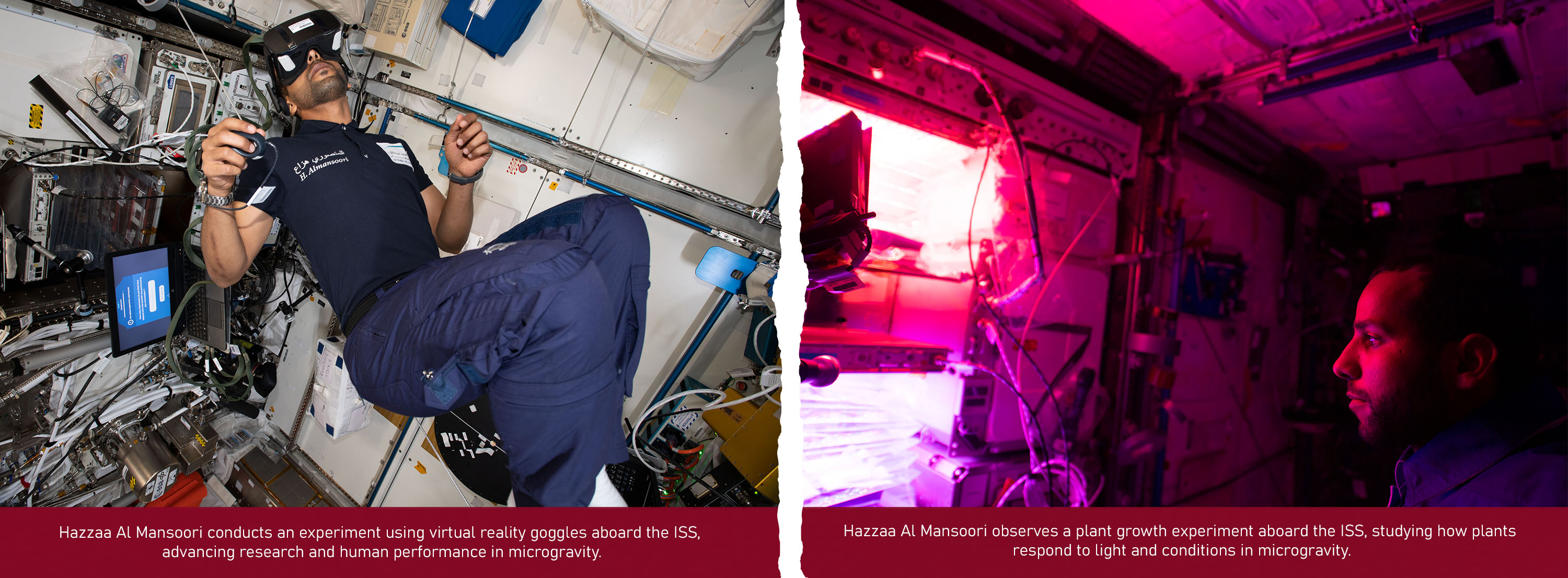
Basically, you wear virtual-reality goggles, a headset, and have a button in your hand. There is a recording you go through, and you have to answer questions like: how long do you think one minute has passed since the session started? Different tasks are used to understand how the feeling of time is perceived in space.
Scientists want to know how being in space and in a floating environment impacts our perception of time itself.
It was a very interesting experiment, and it is still ongoing. I am looking forward to seeing the final results when they are released.
How do you think your mission has influenced the UAE’s role in global space exploration?
Hazzaa: So, when we are talking about space exploration, we are talking about satellites, probes, sending rovers, and also sending humans. It is a full circle.
In the UAE, at Mohammed Bin Rashid Space Centre (MBRSC), since the establishment of the centre back in 2006, the idea has been to start this journey of sending astronauts, building satellites, and developing rovers as we progress.
They began with developing satellites, and we reached the stage where we could develop our own satellites here in the UAE. Then we started the UAE Astronaut Program. At the same time, we sent the Hope Probe to Mars, and we also worked on landing on the Moon with the first Rashid Rover, which unfortunately ended up crashing on the lunar surface. But now we are already working on the second one.
So, it is really a full circle building capabilities on the ground, establishing knowledge, training engineers, developing human power, and continuing with the educational side. All of it is working together.
However, nothing compares to human spaceflight. The impact of seeing someone carrying your flag, speaking your language, and representing your region is a totally different thing. Kids can relate to that more than to machines. That is the new space.
I believe the human spaceflight we conducted here in the UAE has had a huge impact on our culture, our education system, and our industry. And it is ongoing.
Now we are four astronauts. The UAE is part of the Artemis Accords, and we are going to continue our human spaceflights in the future. It is all coming together.
And nothing compares to igniting that spark in kids when I see them walking on the street, in the mall, at schools, or during visits, meeting and interacting with them, I know somehow I am part of that ignition, that spark they now have. They will go on to do amazing things when they grow up and choose their careers.
Did the view of Earth from space change how you think about our planet and its environment?
Hazzaa: Sure, you know, when you are looking at Earth from space you can see many different things. You can see mountains, forests, deserts, rivers, oceans and you can also see forests being destroyed, and pollution in the atmosphere.
You feel really sad about it and you want to change it. Because when we are on board the station, everything is calculated: the temperature, the humidity, the oxygen, the amount of CO₂ inside the station. How we can scrub that, how we can clean the atmosphere everything is measured. There are different pieces of equipment working 24/7 just to make sure we are living in a healthy environment.
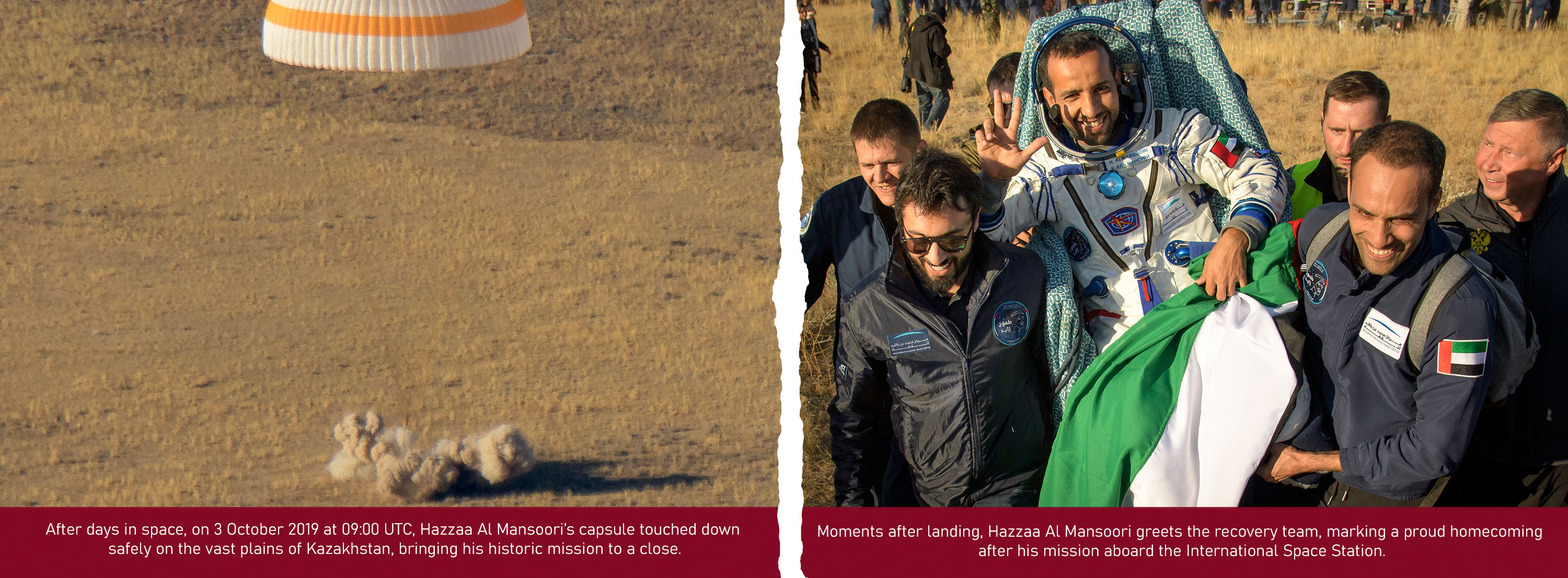
All of this is free here on Earth. Oxygen comes from the trees, and the oceans clean and regulate our climate. All of this is free, but we have to take care of it to make sure it is preserved for generations to come.
So always, when I show pictures of Earth, I tell kids and audiences that they have to take care of this planet because it is the only planet we know where we can live. It is not only for us, not only for our next generation, but for many generations to come.
They have to understand that it is important to take care of our planet, because it is the only ship carrying us through space.
What lessons from your mission will shape future UAE astronaut training?
Hazzaa: Definitely. After my mission and after Sultan’s mission, both of us came up with a plan for how to build sustainable training within our astronaut corps here in the UAE, and how to be prepared for the future.
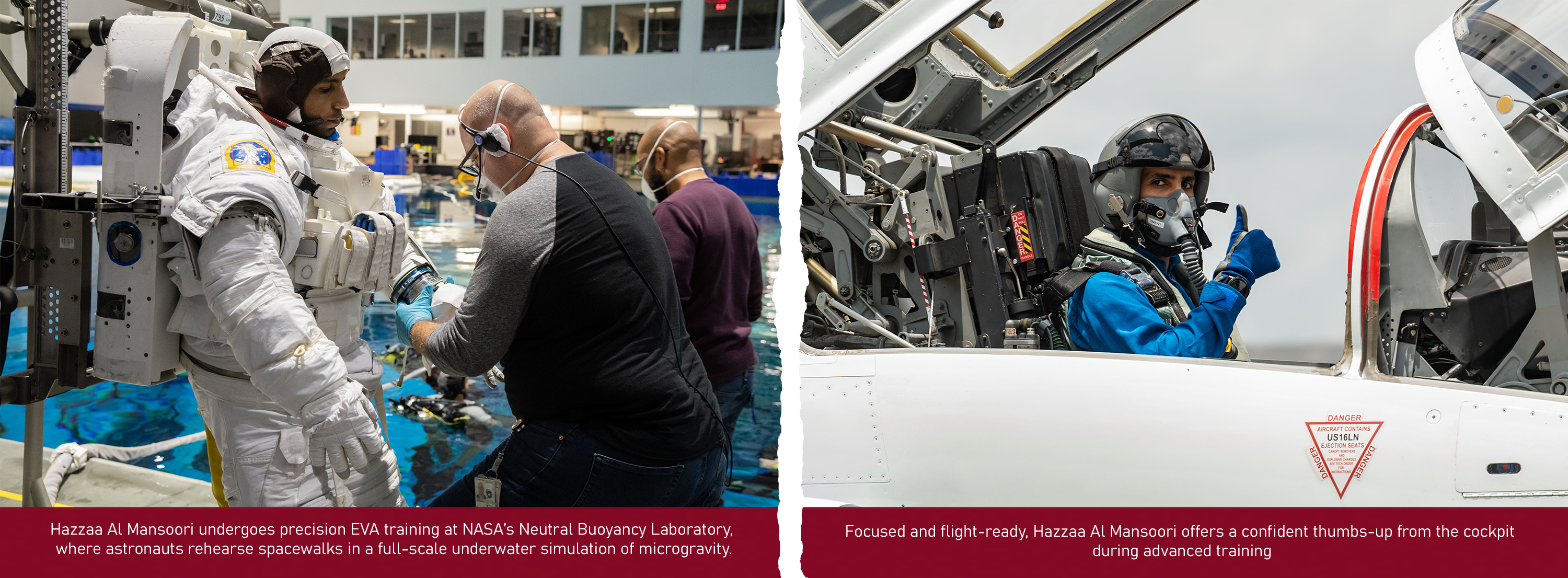
When you are talking about astronaut training, it is ongoing. It includes doing different experiments, conducting scuba diving, and preparing for NBL training at the Neutral Buoyancy Laboratory, which is the largest pool in the world where a submerged mock-up of the station is located. We train in that environment, but we also prepare by doing scuba training here.
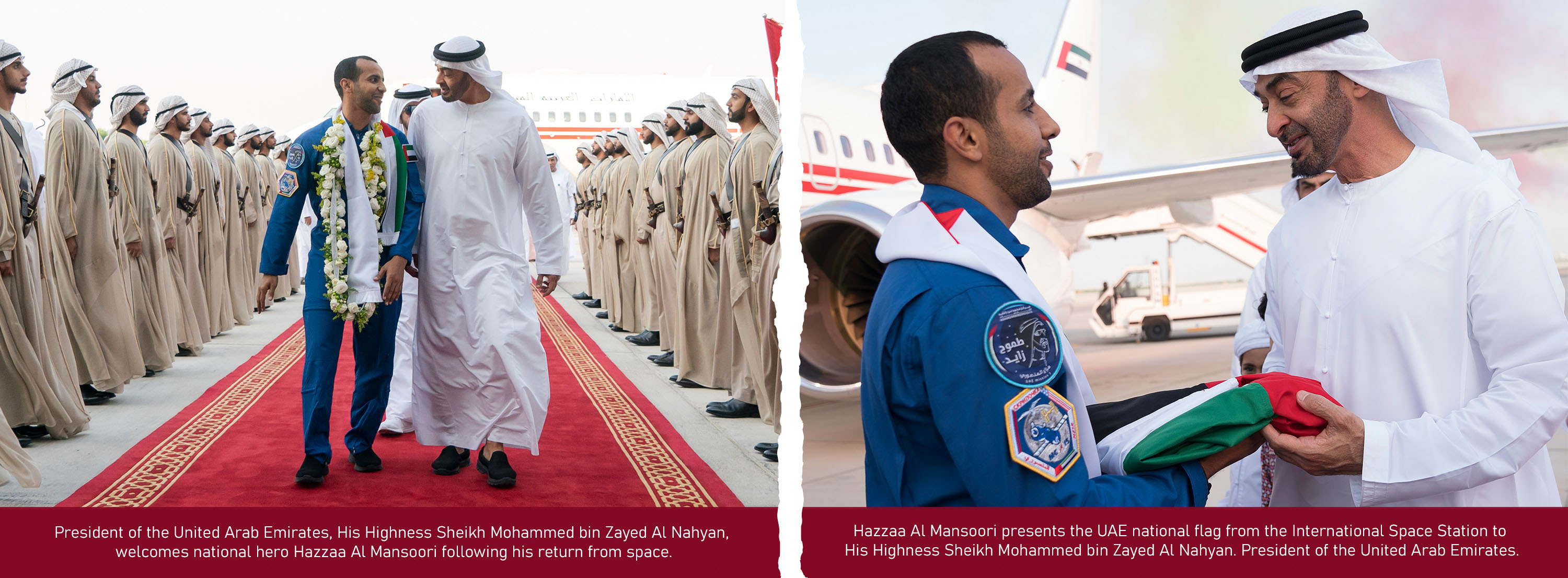
We also focus on soft skills and expeditionary skills like going outdoors, doing geology trips where we learn to study rocks and understand why they are present in certain locations. This helps us build skills for future missions, for example when landing on the Moon, to better understand and collect samples. All of this is part of the preparation for our astronauts, so that if there are future missions to the Moon or beyond, we will be ready.
Another important aspect is learning how to be part of a team by training with astronauts and cosmonauts from other countries. For example, our colleague Mohammed Al Mulla will soon train with ESA astronauts. Together they will practice teamwork and living in harsh environments on Earth such as caves or Antarctica which prepare them for the challenges of working together in space.
Do you see yourself taking part in a Moon or Mars mission, and what excites you most about that possibility?
Hazzaa: So yes, we are living in a very exciting time in terms of human spaceflight. There are big efforts not only from governments, but also from the private sector to participate in space exploration. That is really interesting, and that is exactly what we need to build a culture of space exploration.
Here in the UAE, at Mohammed Bin Rashid Space Centre, we are currently working with our partners at NASA and other agencies on developing the Gateway. As announced before, we are going to build the airlock for the Gateway. That work is ongoing, and we are going to develop that segment, a module of the Gateway station that will orbit the Moon.
As part of that agreement, one of our astronauts will also be sent to take part in the installation of the airlock the first time we will deliver something like this to space.
Personally, I want to go again. I want to experience weightlessness. I want to go and land on the Moon. But at the same time, it is about the team. Whoever goes on that flight will represent the whole country and all of us, the UAE astronauts. We are very excited about it, and we are preparing ourselves now to be ready for that flight.
As we move forward and progress in our timeline, more opportunities will reveal themselves maybe to land on the Moon, or even to send astronauts to Mars. And I can guarantee you that the UAE will always aim to be among the first to Mars, at the first opportunity.
We learned this from our leaders, and we are always preparing as a team at Mohammed Bin Rashid Space Centre training astronauts, preparing people on the ground, building operations and engineers, everything needed for these missions. And if they give me the chance, I will go.
What is your personal message to the next generation of Emirati Arab I would also like to add Pakistani young minds in space exploration?
Hazzaa: So, my message is to have curiosity and passion. If it is about space, keep feeding yourself with knowledge and information, stay up to date, and always remember that if you work hard on yourself mentally and physically and you have the faith, then anything can happen for a reason. You will end up in a good place in your life.
For my Pakistani young generation, I want to tell them that you have a lot of opportunities in the future. If you have a dream, work hard for it and make it happen. Don’t let anyone tell you what you can or cannot do.
Make sure you are prepared mentally and physically. Feed yourself with knowledge. Space is for everyone, but you must show yourself, your skill set, and your ability to compete.
And I believe in the future, hopefully, we will see one of the Pakistani astronauts flying with us and exploring space together.