Environment / Animals / Environment
Aunt and Nephew’s Kingdom
By: MUHAMMAD SHOAIB YAMEEN Published Jan 01, 1970

Among the countless wonders of nature, one of the most exceptional is the feline species and its related members such as lions, cheetahs, leopards, and other predatory cats. Renowned for their superior hunting skills, they reign as the kings or apex predators within their respective ecosystems. This is the only lineage that has upheld its majesty and dominance for approximately 3 to 4 million years. Due to these extraordinary abilities, cats were revered as deities in ancient Egypt. They were held in such high esteem that accidentally killing a cat was punishable by death. If a cat died a natural death in a household, the family members would shave their eyebrows as an expression of mourning.
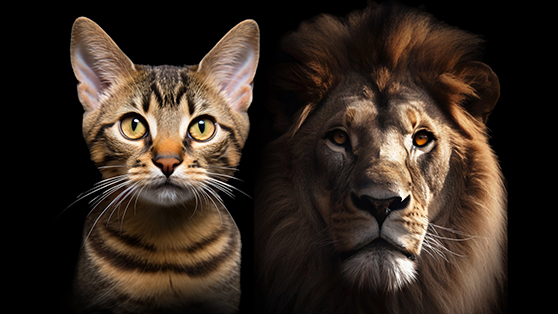
The lion symbolizes agility, cunning, intelligence, courage, and majesty. These traits rightfully earn it the title “King of the Jungle.” Belonging to the larger feline category, it holds the second-highest position in the food chain just after humans. The domestic cat, a smaller relative of the lion, is often affectionately referred to as its “aunt” in cultural idioms. Despite its size, it possesses intelligence and hunting instincts comparable to a small wild leopard. Wherever there is an interest in pet animals around the world, the cat finds a place of honour. As one of humanity’s favourite companions, cats are found in every region of the world—except Australia and Antarctica. Owing to their remarkable adaptability, they thrive in plains, deserts, mountains, snowy regions, and forests, making their presence felt through sheer wit and survival skills.
The margay, a spotted feline of Central and South America, is a gymnastic marvel. With strong and flexible hind limbs, it is virtually untouchable in rainforest environments. It has an extraordinary ability to climb trees and can leap from one branch to another with such speed and grace that predators are left bewildered.
Similarly, the snow leopard, found in icy regions, blends so seamlessly with its snowy surroundings that it could be called a natural master of camouflage. Its unique grey and white coloration makes it extremely difficult to spot. This ability has earned it the title of the undisputed monarch of snow-covered peaks stretching from Siberia to the Himalayas. Fish, being the only available food source in such regions, are expertly caught using its specially adapted forepaws. Its paws are designed by nature to snatch fish from flowing rivers with precision and speed.
In the grassy plains, the leopard stands out with its dark rosettes or spots that allow it to merge with the dappled light of dense forests or the harsh glare of the sun, rendering it nearly invisible. This camouflage enables it to remain hidden from its prey. When it strikes, it does so with stunning surprise, leaving its prey little chance to react. The victim quickly succumbs to the predator’s sharp claws and teeth.
While scientists analyse and explain the biological function of the leopard’s spotted coat, folklore in Ethiopia attributes it to a myth. According to the legend, a powerful man pressed his fingers so firmly into the leopard’s hide that he left behind five black marks—explaining the distinctive spots that now define this majestic predator.
How Does a Cat Work?
The cat is the only animal that, even after 43 million years, has evolved with very little change in its habits, temperament, or structure. Nature designed it with such perfect balance from the very beginning that the passage of time has left almost no impact on its fundamental nature.
If we examine its physical structure, we find that its front limbs are even more flexible than a revolving door. Its spine, beginning from the back of the head and composed of slightly loose joints, plays a key role in its graceful and flexible movement.
Due to this remarkable flexibility, a cat can pass through extremely narrow spaces with ease. We often observe this in daily life—for example, when a cat arches its back to slide under a door through a seemingly impossible gap.
Another advantage of its flexible body is the extraordinary balance it maintains while leaping from high places. Very few animals can match this capability. This was tested just a few years ago when a cat accidentally fell from the 46th floor of a building. Amazingly, it survived with only minor damage to its teeth and not a single scratch on its body.

The cat belongs to the group of animals known as carnivores. Its face is relatively broad, but its jaws are shorter, which results in a powerful bite. In contrast, animals with longer jaws have less gripping power similar to how a short, strong pair of pliers can grip a bolt more firmly than long-nosed pliers designed for small nails.
Another defining feature is its sharp claws, which retract into the paw pads when not needed and extend quickly when required.
Among its other outstanding abilities is its exceptional eyesight. While its vision is sharp during the day, it is especially effective at night or in darkness. A cat’s visual capacity in low light is nearly six times greater than that of the human eye.
All members of this family lions, cheetahs, leopards—possess large, bright, and glowing eyes. These eyes function like built-in binoculars, helping them determine the distance of their prey or locate it when partially hidden in the surroundings. This exceptional visual ability is one of the feline family’s most crucial survival tools.
Smilodon (Saber-toothed Cat)
This species belongs to the ancient world. A creature resembling a lion, the Smilodon ruled the ancient Earth for approximately 8 million years. Then, around 10,000 years ago, it expanded its territory into North America. Weighing around 320 pounds, the Smilodon was a heavily built animal with extremely strong forelimbs, a broad chest, and dangerous, sharp, and powerful jaws. One can witness the grandeur of its physique through the fossilized remains preserved at a museum located west of Los Angeles. The way these Smilodon fossils were preserved is also a fascinating story.
If we look back 10,000 years, the present-day city of Los Angeles was covered with pine and other trees. At that time, deep beneath the ground—sometimes over a thousand feet—black liquid from petroleum deposits would seep upward and eventually reach the earth’s surface. This black substance was later discovered and named asphalt.
As this liquid pooled into pits on the surface and mixed with the soil, it appeared deceptively harmless—but in reality, it formed treacherous tar pits. If an unfortunate animal ever got trapped in this substance, escape became nearly impossible.
For the Smilodon, such a scenario was an unexpected blessing. Standing at the edge of the pit, it would use its powerful jaws to drag out the trapped prey and feast on it. However, the same pit that offered easy prey could also become a deadly trap for the predator itself. Once caught, there was no escape, and soon it too would succumb, becoming eternally preserved in the asphalt.The Page Museum’s collection manager shared his thoughts:
“Asphalt is an incredible preserver.”
In 1975, an extraordinary event took place. During excavation for the museum’s construction, workers uncovered two complete saber-toothed skeletons in the exact position typical of a cat’s death posture. Unlike the usual fossilized remains, which were found disassembled or scattered, these skeletons were discovered fully intact for the first time.
Upon detailed examination, one significant discovery stood out: a bone in the heel, previously thought to be a thumb bone, turned out to be part of the middle toe. As a result, volunteers dedicated their holiday time to reorganizing the museum’s entire fossil collection based on this new finding.
Hunting Method

Larry Martin, who is researching Smilodon and other animals of this tribe, explains the hunting technique by saying that the two large, sharp front teeth of the Smilodon had tremendous power to immobilize its prey. He demonstrated this by comparing it to a sharp, curved knife used in the Middle East.
According to Larry Martin, many experts believe that the Smilodon used its long, sharp teeth to sever the neck of its prey. However, he disagrees with this theory. After careful examination of the teeth’s structure, it appears that the Smilodon attacked the prey’s throat and used its sharp teeth to cut the windpipe, causing rapid bleeding. This would quickly render the prey unconscious, causing it to collapse lifelessly to the ground.
Another theory suggests that the Smilodon’s hunting method was similar to that of a lion, which attacks the soft skin of the prey’s belly, then clamps down on the neck from behind. However, it is difficult to say which of these methods is more accurate because there is no closely related living species today to serve as evidence or comparison.
This raises the question: how did such a magnificent creature disappear from the forests, leaving no closely related animals behind? There are two main explanations for this.
Number 1:
Climate change resulted in the disappearance of vegetation, causing herbivores—prey for the Smilodon—to either become extinct or migrate to other regions. This shortage of food ultimately led to the extinction of this great species.
Number 2:
The arrival of humans in the ecosystem had a significant impact. Humans began cutting forests and killing animals, which consequently caused the decline of the Smilodon. Even today, 37 species of wild cats—including lions, cheetahs, and others—face threats to their survival.
A cheetah or lion, when hungry, can eat between 60 to 80 pounds of meat in one night, whereas other carnivores such as bears may survive on plants and leaves if meat is unavailable. After consuming such a large amount of meat, a lion or cheetah can go several days without eating.
This can be estimated from a report by the World Conservation Union based in Switzerland, which states that the cheetah population, which was 51,000 in 1979, has now reduced to only 10,000. Similarly, out of 11,000 tigers, only 6,000 remain. The rapid decline in these species is due to the use of their bones in traditional Asian medicines and the growing demand for their skins in the rest of the world.

Asian tigers have suffered the most damage due to traditional doctors who mercilessly used tiger bones in the preparation of medicines, leading to the ruthless killing of a large number of tigers. Additionally, the beautiful skins of lions, cheetahs, and leopards have become a threat to their survival. The increasing demand for their skins (fur) in the international market and high prices have fueled illegal hunting, which still continues with the collusion of forest officials and others in African and Asian countries.
If we call the golden era of big cats, including lions, cheetahs, tigers, and leopards, it would be the period about ten million years ago when there was an abundance of herbivores like grass-eating ungulates in the forests. The plentiful presence of these herbivores in vast forests provided great opportunities for large carnivorous cats like lions to flourish.
However, as human influence on forests increased, forests were cut down, and herbivores migrated to unknown places. As a result, lions, cheetahs, and others either died out due to lack of food or were hunted by humans. Those that survived are now so few in number that they are counted among endangered species.
Another interesting characteristic of cats is their ability to adapt and camouflage themselves in their surroundings. For example, the spotted cat changes its color to a wild gray shade. This color change plays a key role in protecting them from enemies and also helps them remain unseen by their prey. The black vertical stripes on the Asian tiger’s body allow it to blend into tall dry grass, making it very difficult to spot.
As the climate became colder, this family of cats split into two large groups. One group belonged to the long-toothed Smilodon, which ruled the earth for a time but became extinct due to changes in the natural environment, closing a golden chapter. In contrast, the other group included lions, cheetahs, tigers, Iranian and Siamese cats, who fought bravely against all dangers and environmental changes and continue to survive in their original form to this day.
The art of domesticating cats was first learned by the Egyptians. Since then, various breeds of domestic cats have been kept as pets. This process began around 2000 BC when cats held a highly sacred status in Egypt. This sacred position led to ancient Egyptians giving cats divine status. The importance of cats in Egypt can be gauged from the report of the Greek historian Herodotus, who said:
“And if a cat died in the house of an ancient Egyptian, all the family members would shave off their eyebrows with a razor.”
This is a report given by a Greek historian about the Egyptians. Commenting on this report, the head of the research institute at the British Pyramids stated that this report is as significant as salt in flour when it comes to showing the respect and status cats held. This is why, in the pyramids where mummified bodies and tombs of Egyptian kings and high officials are found, similarly, mummified cats were also discovered, buried in proper tombs. Among the cats that were given divine status in ancient Egypt, the highest rank was held by the Sphinx. If you ever get a chance to visit the pyramids in Egypt, early in the morning when the sun rises, the very first ray of sunlight falling on the pyramid bears a historic inscription of Egypt’s powerful ruler, the Pharaoh, which reads:
“I shall transform into the most powerful member of the cat family, in the form of a lion.”
In the modern era, many new things have become part of people’s lifestyles, among them is keeping a pet. Cats and dogs top the list of such pets, but in the United States of America, cats have surpassed dogs. According to verified statistics, there are 66 million pet cats in the U.S., significantly more than the 55 million pet dogs. This is not because Americans have more affection for cats but because cats require less care than dogs, making them easier to accommodate in today’s fast-paced lifestyle. In contrast, in France, the situation is the opposite, where a large part of the population prefers keeping dogs over cats. When this difference was inquired about from a British archaeologist, she explained succinctly, with her characteristic wit: “Cultural differences.”
Experts say that domestic cats enjoy two distinct lifestyles. As pets, they receive all the comforts provided by their owners, while simultaneously fulfilling their wild instincts by hunting small birds and other animals, thus enjoying a dual life.
“Nature has endowed cats with an extraordinary sixth sense their whiskers through which they can successfully hunt even in very difficult places. According to an expert, a blind cat can find its way using only this sense and its ears.”
If a competition were ever held to decide which is smarter—cats or dogs—it would be a difficult task because if the test is designed according to their natural instincts, both excel in their own domains. For example, if the challenge involves understanding human hand signals, the dog would inevitably win. However, if the challenge were to catch a mouse hiding in grass and leaves, the cat would triumph.
In short, the cat is a divine masterpiece of creation. If studied carefully with observation and reflection, it is no surprise that cats embody principles that have guided modern science. It is the only animal that, while being domesticated, still retains its ancient hunting instincts.