Technology / Aviation
F-35 Lightning II: America’s Fifth-Generation Multi-role Fighter
By: Adnan Razi Khan Published Aug 23, 2025
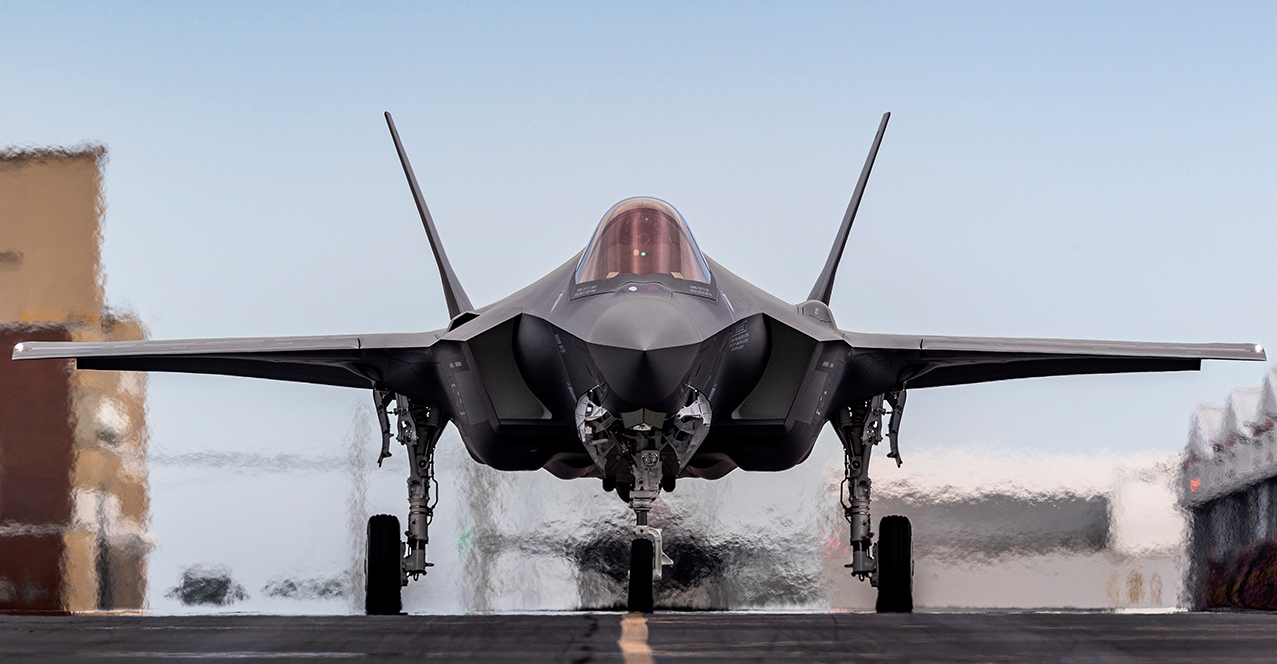
The F-35 Lightning II is the most advanced multirole combat aircraft ever produced, combining stealth, supersonic speed, sensor fusion, and unmatched versatility. To understand why the F-35 program was launched, we must first look at what the United States lacked before its development and how it came to dominate the future of aerial warfare.
Why the USA Needed the F-35
Before the F-35 program, the U.S. military relied on fourth-generation aircraft such as the F-15 Eagle, F-16 Fighting Falcon, and F/A-18 Hornet. While effective in their time, these platforms lacked stealth technology, advanced sensor fusion, and true multirole flexibility. With adversaries like Russia developing the Su-57 and China advancing stealth fighters such as the J-20, the U.S. urgently needed a fifth-generation aircraft capable of defeating high-end threats, surviving dense air defense networks, and carrying out precision strike missions. The F-35 was designed to be this solution.
From Competition to Selection: X-32 vs X-35
In 1993, the Department of Defense initiated the Joint Strike Fighter (JSF) program to develop a single family of fighters for the Air Force, Navy, and Marine Corps. Boeing’s X-32 and Lockheed Martin’s X-35 prototypes went head-to-head in a competition that tested stealth, agility, affordability, and adaptability to three variants: a conventional takeoff and landing (CTOL), a STOVL F-35B variant, and a carrier-based model. Lockheed’s X-35 outperformed Boeing’s entry, particularly in STOVL demonstrations where it transitioned smoothly from supersonic flight to vertical landing. Boeing’s design struggled with weight and maneuverability. In 2001, Lockheed Martin was declared the winner, giving birth to the F-35 Lightning II.
First Flight and Weapons Testing
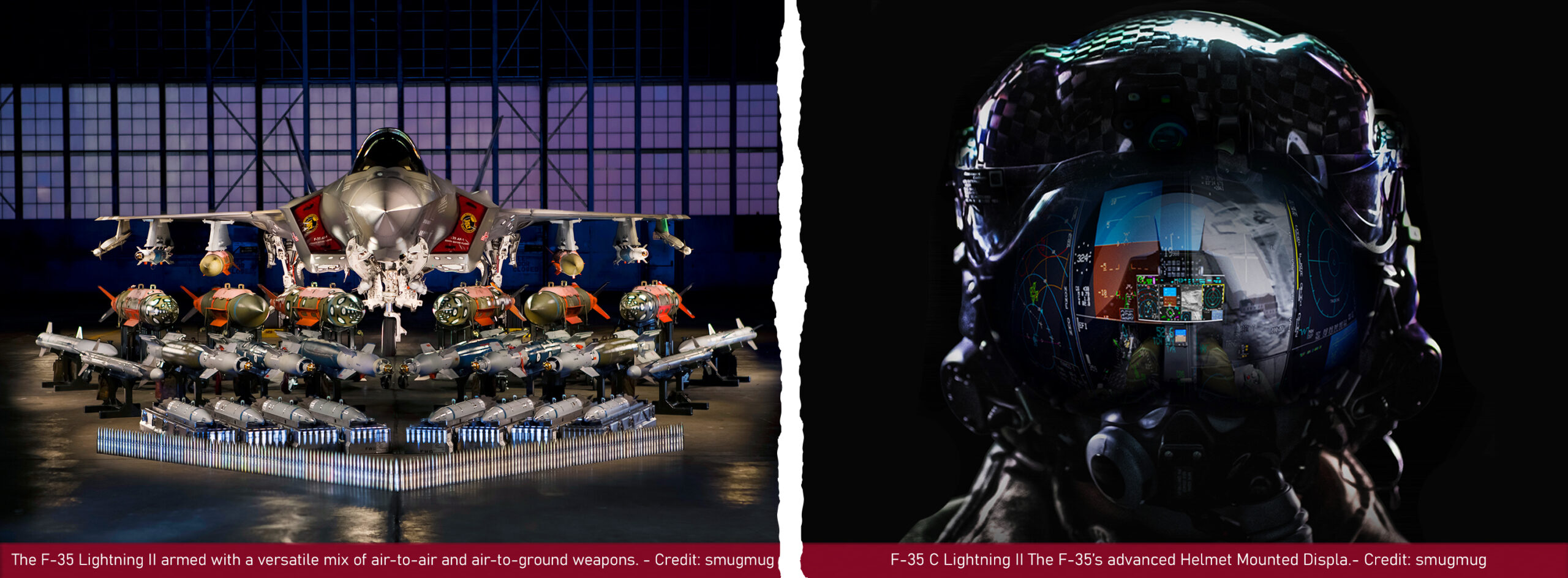
The first F-35A flew on December 15, 2006, from Fort Worth, Texas. By 2012, the aircraft had completed its first live weapons release, dropping precision-guided bombs while retaining stealth. Testing later validated the use of AIM-120 AMRAAM, AIM-9X Sidewinder, GBU-12 Paveway II, JDAMs, and Small Diameter Bombs. Continuous integration ensures future compatibility with advanced long-range missiles like the AGM-158 JASSM and anti-ship LRASM.
Production and Global Orders
The Pentagon originally planned 2,456 aircraft across U.S. services. More than 1,200 have been delivered globally. Key operators include:
• United States
• United Kingdom
• Italy
• Japan
• Israel
• South Korea
• Australia
• The Netherlands
• Norway
• Denmark
• Finland
• Switzerland
The F-35 has become the backbone of NATO’s and allied nations’ future airpower.
Technical Capabilities and Targeting Systems
The F-35 is equipped with the AN/APG-81 AESA radar, capable of tracking up to 20 targets simultaneously and engaging several at once with beyond-visual-range missiles. In air-to-air combat, the aircraft can detect enemy fighters at ranges exceeding 150 kilometers. Sensor fusion integrates radar, infrared, and electronic warfare inputs into a single pilot display, reducing workload and increasing situational awareness.
The Distributed Aperture System (DAS) provides real-time 360-degree coverage, allowing the pilot to “see through” the aircraft via the helmet-mounted display (HMD). The Electro-Optical Targeting System (EOTS) delivers long-range tracking and laser designation for precision strikes. In night or adverse weather, these systems give the F-35 unmatched targeting and survivability.
Flight Control, Avionics, and Safety Systems
The F-35 uses a quadruple-redundant digital fly-by-wire control system, ensuring stability and responsiveness in all flight conditions. Avionics include a Panoramic Cockpit Display (PCD), a 20-inch touchscreen that integrates maps, weapons, communications, and navigation. The HMD projects real-time flight data, weapons lock, and night-vision imagery directly onto the pilot’s visor.
For safety, the F-35 is equipped with Martin-Baker US16E ejection seats, designed to protect pilots across the flight envelope, including at low speeds and high altitudes. Automatic Ground Collision Avoidance Systems (Auto-GCAS) reduce the risk of crashes during pilot disorientation.
Engine and Powerplant
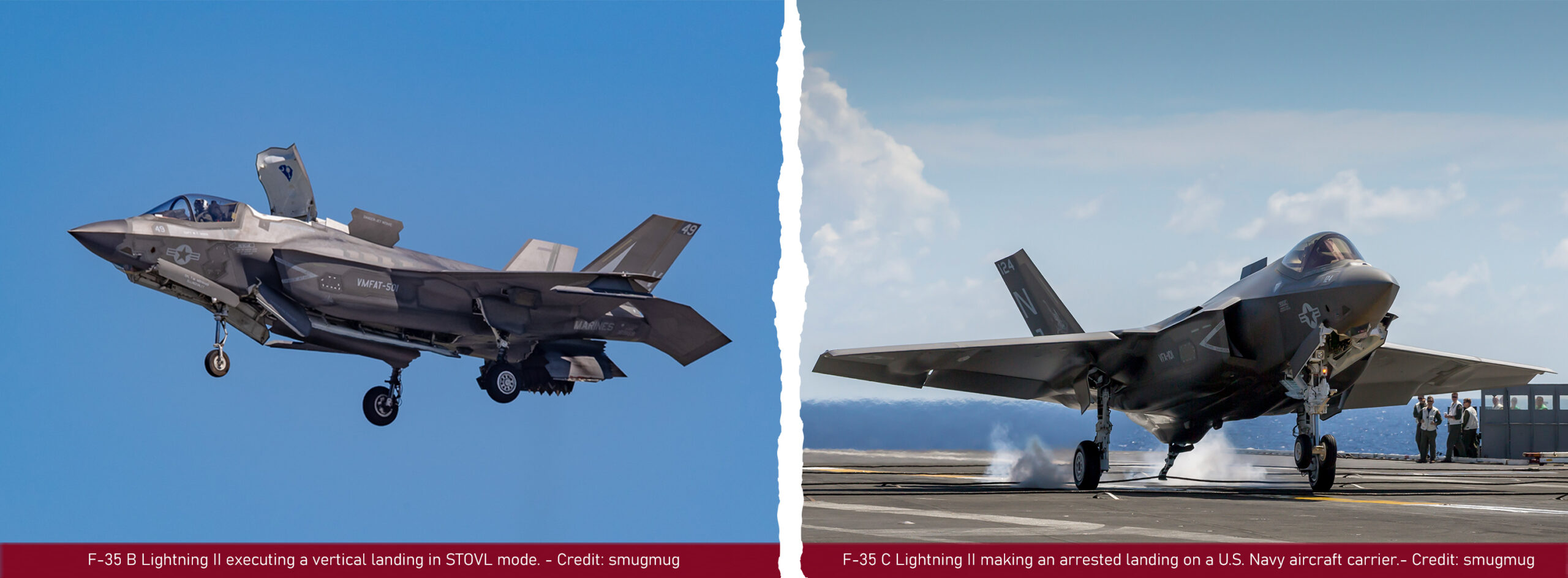
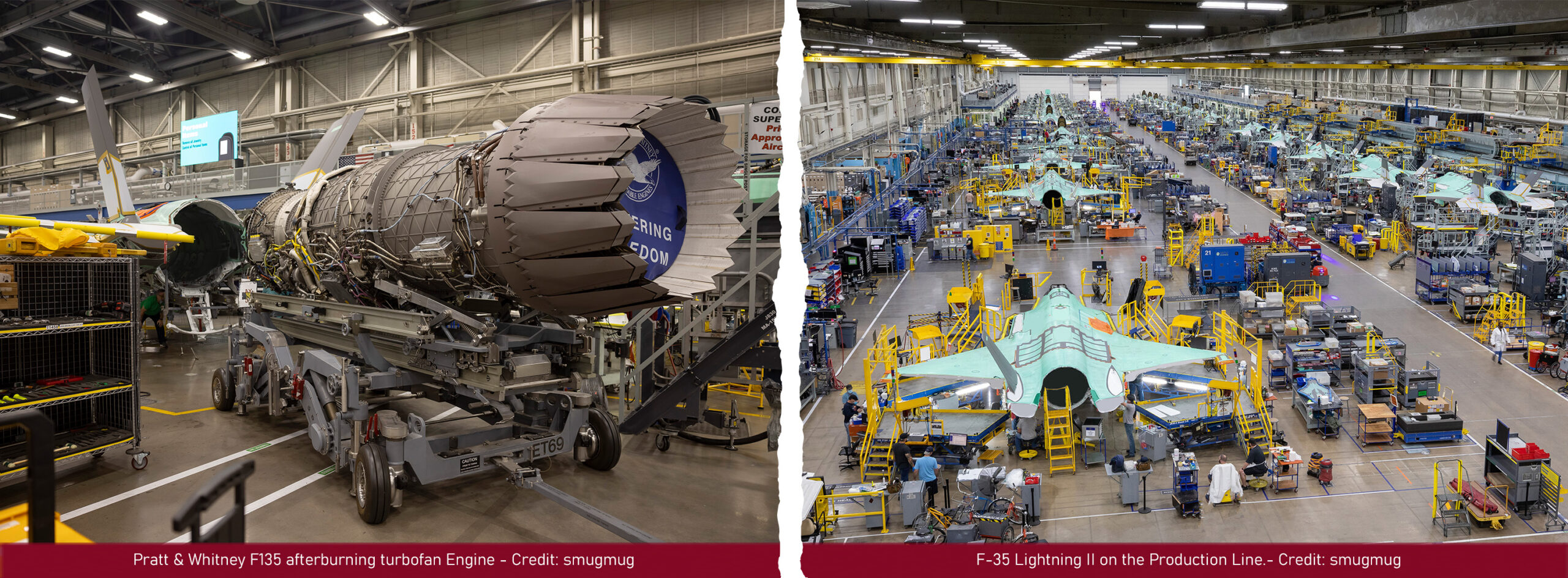
All F-35 variants use the Pratt & Whitney F135 afterburning turbofan, producing 28,000 lbs thrust dry and 43,000 lbs with afterburner. The engine enables a top speed of Mach 1.6. The F-35B variant adds a Rolls-Royce LiftFan system, enabling vertical landings and short takeoffs from small carriers and forward bases. The F135 is the world’s most powerful fighter engine and incorporates a stealth nozzle design to reduce infrared signature. The aircraft’s maximum altitude is about 50,000 feet.
Maneuvering and Combat Capabilities
Though not designed as a pure dogfighter, the F-35 is highly maneuverable thanks to its digital flight controls, high thrust-to-weight ratio, and stealth. In beyond-visual-range (BVR) engagements, its radar and missiles dominate, while in within-visual-range (WVR) fights, high off-boresight targeting through the HMD gives it an edge. The jet can simultaneously engage multiple enemy aircraft, launch radar-guided AMRAAMs at long range, and transition to infrared-guided AIM-9X missiles in close combat.
Specifications
Length: 51.4 ft (15.7 m)
Wingspan: 35 ft (10.7 m)
Height: 14.4 ft (4.38 m)
Maximum Speed: Mach 1.6 (1,200 mph, 1,930 km/h)
Combat Radius: ~670 miles (1,080 km)
Ferry Range: ~1,380 miles (2,220 km)
Service Ceiling: 50,000 ft (15,240 m)
Radar: AN/APG-81 AESA, >150 km range
Weapons Capacity: 18,000 lbs internal and external
Cockpit Display: Panoramic touchscreen + HMD with augmented reality
Airframe: Carbon-fiber composites, radar-absorbent coatings
Armaments
The F-35 can carry a wide spectrum of weapons:
Air-to-Air: AIM-120 AMRAAM (range ~180 km), AIM-9X Sidewinder (short-range, high off-boresight)
Air-to-Ground: JDAM, Paveway II/III, Small Diameter Bombs, AGM-154 JSOW
Anti-Ship: AGM-158C LRASM (future integration)
Anti-Radiation: AGM-88 HARM upgrades
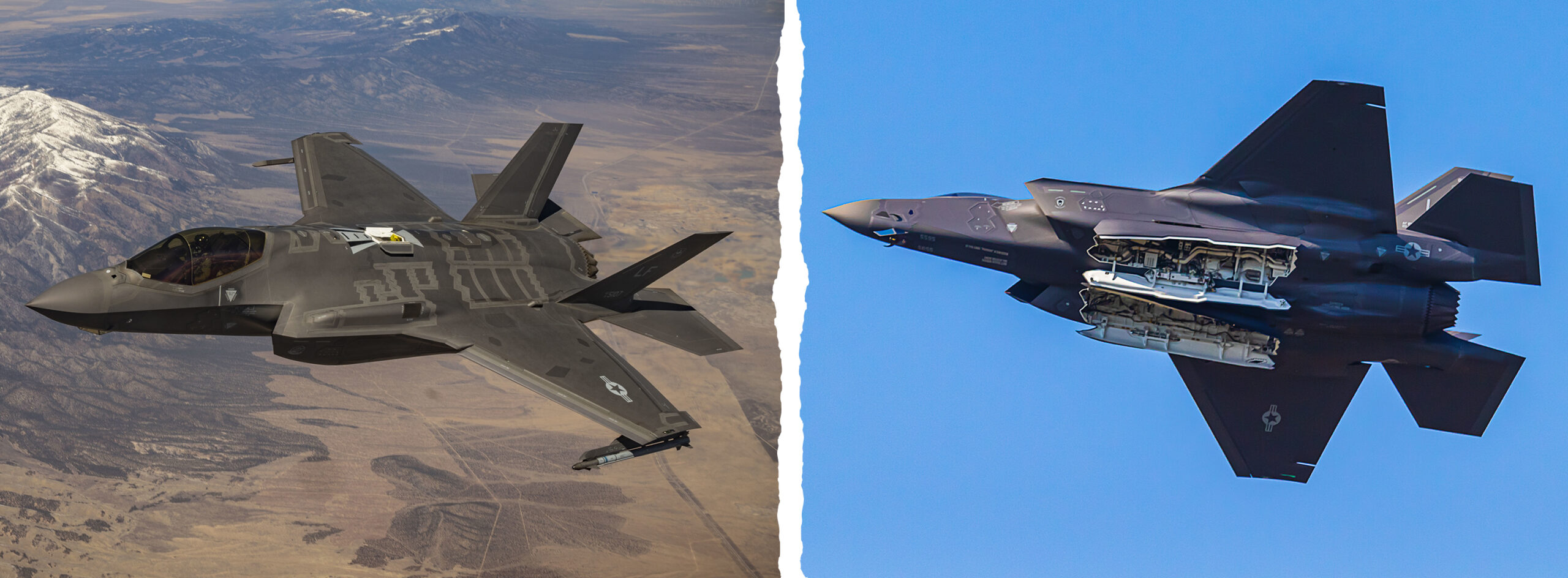
Gun: GAU-22/A 25mm cannon, internal on F-35A, podded on F-35B/C
F-35 Helmet Mounted Display (HMD)
The F-35 does not use a traditional Head-Up Display (HUD). Instead, it employs the revolutionary Helmet Mounted Display System (HMDS), developed by Elbit Systems and Collins Aerospace. This helmet gives pilots unparalleled situational awareness and essentially becomes the cockpit’s central interface.
The HMDS projects critical flight data, targeting information, and navigation cues directly onto the pilot’s visor. Unlike conventional HUDs limited to forward view, the helmet provides a 360-degree “see-through” capability by integrating inputs from the aircraft’s Distributed Aperture System (DAS). This allows the pilot to look “through” the aircraft’s airframe and view the outside environment in real time.
The system includes:
• Night Vision Integration: Built-in sensors eliminate the need for separate night vision goggles.
• Target Tracking: The pilot can lock onto targets simply by looking at them.
• Symbology: Weapon status, speed, altitude, and mission data are displayed directly in view.
• Custom Fit: Each helmet is 3D-scanned and tailored to the pilot’s head for precision alignment and comfort.
At a cost of around $400,000 per unit, the F-35 helmet is more expensive than many luxury cars — but it transforms the jet into an extension of the pilot’s body, ensuring unmatched combat effectiveness.
Combat Experience and Mishaps
The F-35 has steadily transitioned from a developmental platform into a proven combat aircraft across multiple regions of the world. Its first confirmed operational use came in 2018, when the Israeli Air Force employed its F-35I “Adir” in precision strike missions in Syria. Israel became the first country to use the aircraft in combat, and its commanders praised the jet’s ability to penetrate dense air defense systems while remaining undetected.
Since then, the F-35 has been deployed by U.S. forces in Afghanistan, Iraq, and Syria. U.S. Marine Corps F-35Bs aboard amphibious assault ships conducted their first combat strike in Afghanistan in September 2018, targeting Taliban positions. The U.S. Air Force followed in April 2019, employing F-35As from Al Dhafra Air Base (UAE) against ISIS targets in Iraq.
Other allied nations have also begun employing the jet operationally. The UK’s Royal Air Force and Royal Navy deployed F-35Bs from HMS Queen Elizabeth during operations in the Mediterranean in 2021. Japan, Italy, and Norway have also integrated their fleets into NATO missions, though without confirmed combat use.
Despite its successes, the program has seen mishaps:
• United States: F-35B crash (2018) – faulty fuel tube; F-35A crash (2020) – night landing, pilot disorientation; F-35C crash (2022) – USS Carl Vinson, later recovered.
• Japan: F-35A crash (2019) – Pacific Ocean, spatial disorientation.
• United Kingdom: F-35B crash (2021) – HMS Queen Elizabeth, intake cover ingestion.
• Other incidents: Runway overruns and ground accidents, fewer than two dozen global losses.
Each mishap has led to concurrency upgrades — software, hardware, and training improvements applied fleet-wide, steadily improving safety and reliability.
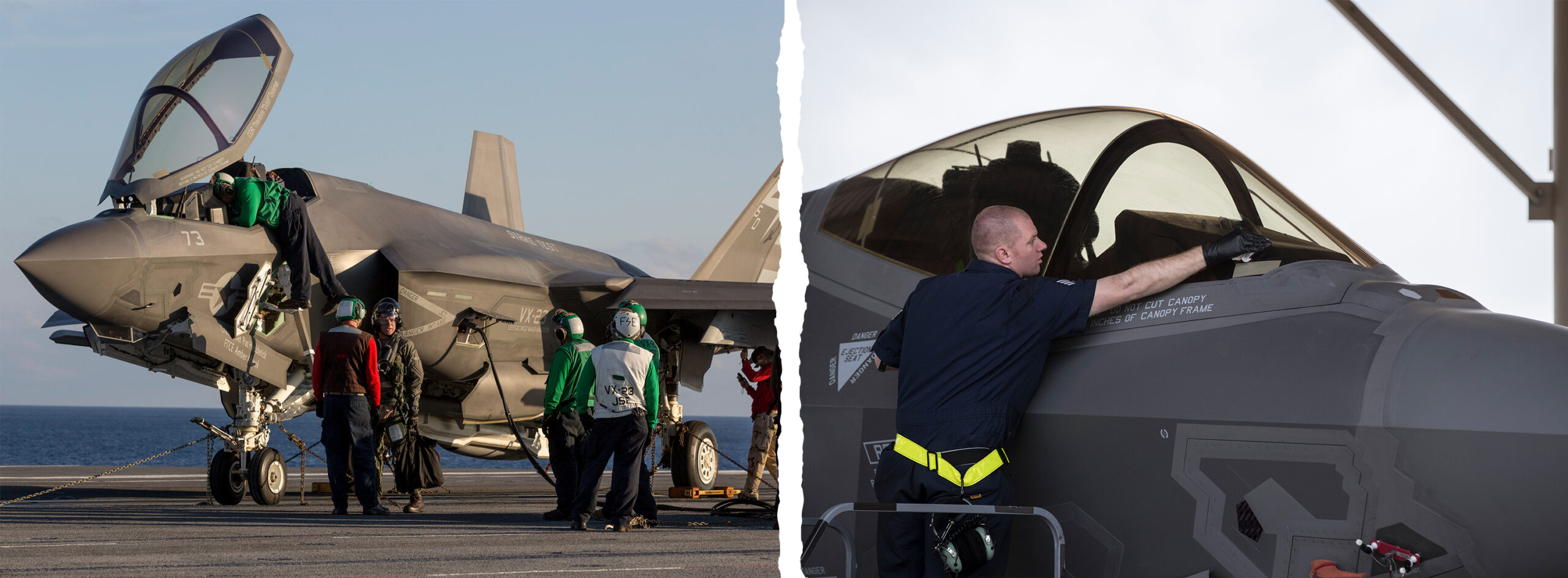
Costs and Maintenance
F-35A: ~$80 million
F-35B: ~$100 million
F-35C: ~$94 million
Operating cost: $33,000–$44,000 per flight hour
Maintenance: Engine inspection every 250–300 hours, regular avionics & stealth coating upgrades
Total program cost: ~$1.7 trillion (lifetime)
International Collaboration
The F-35 Lightning II is not just an American aircraft; it is the centerpiece of one of the most ambitious international defense collaborations in history. The program was designed from the outset as a multinational effort, with partner countries sharing costs, technology, production responsibilities, and future maintenance. This approach not only spreads development expenses but also ensures allied interoperability in future conflicts.
United States
• Lockheed Martin serves as the prime contractor, overseeing design, assembly, and systems integration.
• Pratt & Whitney produces the F135 engine, the most powerful fighter engine in the world, with thrust exceeding 43,000 lbs.
• U.S. facilities also coordinate software development, stealth coatings, and mission systems integration.
United Kingdom
• The UK is the only Level 1 partner in the program and has invested heavily in its success.
• BAE Systems manufactures the aft fuselage, vertical tails, and contributes to avionics and flight control systems.
• The UK also co-developed key aspects of the STOVL F-35B variant, ensuring its suitability for Royal Navy carriers.
Italy
• Italy, a Level 2 partner, plays a central role in European F-35 production.
• Leonardo (formerly Alenia Aermacchi) builds major wing components and operates the Final Assembly and Check-Out (FACO) facility in Cameri, one of only two global assembly lines outside the U.S.
• The Cameri facility not only produces Italian F-35s but also assembles aircraft for other European customers, such as the Netherlands, and acts as a regional maintenance hub.
Australia
• Provides structural components, composite panels, and titanium castings for every F-35 produced globally.
• Hosts Pacific sustainment hubs for airframe and engine maintenance, ensuring long-term support for fleets across the Asia-Pacific.
Norway and Denmark
• Both countries contribute advanced structural parts, electronic components, and support systems.
• Norway developed the Joint Strike Missile (JSM), specifically designed to fit inside the F-35’s internal weapons bay — extending its strike capabilities.
Netherlands
• Produces flaperons (control surfaces) and other advanced composite structures.
• Plays a major role in European-level logistics and sustainment for allied F-35 fleets.
Canada
• Though not yet an F-35 operator (decision finalized in 2022 to procure F-35As), Canada has long participated as an industrial partner.
• Canadian companies supply electrical wiring, landing gear components, and composite structures.
Turkey (past involvement)
• Initially a partner and planned customer, Turkey contributed to production of fuselage parts, landing gear, and avionics.
• In 2019, Turkey was suspended from the program after purchasing the Russian S-400 air defense system. Production responsibilities were redistributed among other partners.
Japan
• While not an original JSF partner, Japan is now the largest foreign customer, with plans for more than 140 F-35s.
• Operates a domestic assembly and check-out line at Nagoya, run by Mitsubishi Heavy Industries.
• Japanese industry contributes advanced composite parts and avionics.
Israel
• Israel received a custom variant, the F-35I “Adir”, with locally integrated electronic warfare systems and weapons.
• Israeli industry (IAI and Elbit Systems) contributes to wings, avionics software, and helmet-mounted display technology.
This multinational collaboration ensures that the F-35 is not only a U.S. fighter but a shared allied project, enhancing interoperability among NATO members and partners. Every F-35 flying today contains parts manufactured on multiple continents, symbolizing an interconnected defense strategy for the 21st century.
The Future Beyond the F-35
The F-35 program is designed to remain in active service until at least 2070, ensuring decades of frontline relevance. However, military planners are already preparing for the next leap in aerial warfare through the Next Generation Air Dominance (NGAD) program. Unlike the F-35, which was conceived as a single airframe adaptable to multiple roles, NGAD envisions a “system of systems” approach — combining a manned sixth-generation fighter with a network of unmanned drones, satellites, and ground assets working together.
Key features expected in NGAD include:
AI-assisted combat operations: allowing pilots to focus on decision-making while onboard systems and drone “wingmen” handle targeting, navigation, and threat detection.
Optional unmanned flight capability: enabling the aircraft to be flown remotely or autonomously in high-risk missions.
Directed-energy weapons: such as high-powered lasers designed for missile defense, electronic warfare, and potentially even air-to-air combat.
Enhanced stealth and survivability: with adaptive camouflage, thermal signature reduction, and radar-absorbing materials more advanced than anything currently deployed.
Next-generation propulsion systems: capable of longer range, higher speeds, and potentially incorporating hybrid or adaptive engines for efficiency and performance.
Until NGAD enters service expected in the 2030s the F-35 will remain the backbone of allied airpower, not only for the United States but also for over a dozen partner nations. With continuous software upgrades, modular hardware improvements, and integration into advanced data-sharing networks, the F-35 is evolving into a true force multiplier that bridges the gap between current fifth-generation fighters and the revolutionary sixth-generation designs on the horizon.