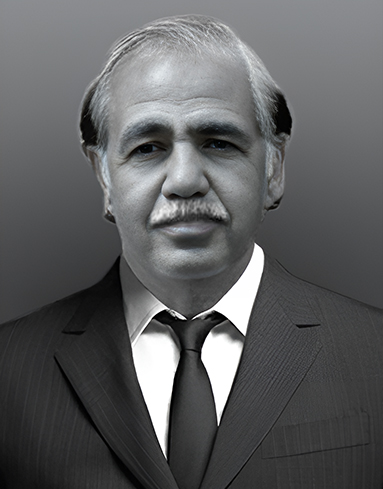
Meeting with Einstein’s student, former Vice-Chancellor of four universities, and one of the great mathematicians of the twentieth century — Dr. Muhammad Raziuddin Siddiqui
By: Raziuddin Khan Published Feb 02, 1998

“The death of a scholar is the death of the world.”
On 2nd January 1998, Pakistan lost one of its most illustrious sons, a towering figure of knowledge, learning and science, and one of the greatest mathematicians of the modern era, Professor Dr Muhammad Raziuddin Siddiqui. With his passing, Pakistan was deprived of an invaluable and boundless fountain of enlightenment. Personalities of Dr Siddiqui’s calibre are born only once in centuries. Undoubtedly, he was a priceless asset to Pakistan. Alongside his countless contributions, he rendered immense and invaluable services toward the promotion and advancement of education and science in this country. He served as the Vice-Chancellor of four universities, two of which he founded as their first Vice-Chancellor. On the occasion of his sad demise, the Science Digest team expresses heartfelt condolences to his bereaved family and prays that Almighty Allah grants him forgiveness and elevates his station in the hereafter, Ameen.
An interview with Dr Siddiqui was published in the third issue of Science Digest (May 1981). On this occasion, we are republishing it for our readers.
If I had the power, I would ask the dust, O vile one,
What have you done with those priceless treasures
I had known his name for a long time and, sharing the same name, I was especially eager to meet him and hear his thoughts, but there never seemed to be a suitable opportunity. In our student days, it was never easy to gain access to such eminent and renowned figures. It wasn’t until a year and a half after my student years had ended in early 1972 that I finally got my chance, at the Thirteenth Annual Science Conference held in Karachi, presided over by Dr. Raziuddin Siddiqui.
The atmosphere at the Science Conference was rather subdued and quiet, owing to the fact that only three months earlier the nation had endured a great political and ideological tragedy that had shattered the nerves of every citizen. In such a delicate and dispiriting environment, addressing a large gathering of scholars and intellectuals and offering a meaningful insight was a true test of resolve. One also had to remain mindful of the changed mood of the time. In his presidential address, Dr. Siddiqui remarked: “It is regrettable that even those scholars who deal with scientific and physical phenomena, who base their conclusions on evidence and observation and are entirely satisfied with their findings, still allow for some margin of error. Yet strangely enough, when these very people turn to social, humanistic, or political matters, which are far more intricate and complex than the natural sciences, they insist on their views with a conviction as absolute as if they possess certainty of the highest order.” That was the first time I had the opportunity to listen to Dr. Siddiqui.
Even after that conference, I had the privilege of seeing Dr Siddiqui a few more times, but those meetings were brief and distant. However, towards the end of 1979 I finally had the opportunity to sit down for a detailed meeting and conversation with him. In Dr Siddiqui’s own words, I was the first person with whom he had engaged in such a long and uninterrupted discussion, approximately six hours in a single sitting. This eminent and distinguished scientist of Pakistan, who had the honor of working alongside a great scientist like Einstein, is a priceless asset to our nation. Today, we are proud to present this scientific luminary to our readers.
Question:
Please share some details about your family background and circumstances.
Answer:
Our family belonged to a lineage of judges and magistrates in Hyderabad Deccan. In our family, the initial education was focused on Islamic studies. This is how I began acquiring knowledge of Persian and Arabic. In our seminary, known as Madrasa Darul Uloom, along with Arabic and Persian, subjects such as history, geography, mathematics, and science were also taught. The teachers themselves noticed that besides other subjects and languages, I had a special passion for mathematics and science. For this reason, my results in these subjects were always very good. In fact, my mind is analytical, which is why I chose to focus on mathematics and science.
Question:
How was your student life and how do you feel about it today?
Answer:
In our time, education was personalized and individual. The number of students was small. Teachers taught students with great enthusiasm and kindness. Since I was considered a good student, the teachers were very affectionate and kind toward me. Whenever they were busy or absent, I was asked to teach the other students of my class. This continued up to the university level. I used to study myself and also taught my fellow students. When I joined university, I scored very good marks in all subjects science, Mathematics, Arabic, and Persian. This caused a dispute among our language and science teachers about what I should study. The Arabic, Urdu, and Persian teachers said I was talented in those subjects, so they wanted me to continue with languages. The science teachers argued that I was more suited for scientific subjects. I thought if the two sides could not come to an agreement, I would express my own choice, but the situation never arose.
It was decided that since science subjects require laboratories, they could only be studied at college, whereas Arabic, Persian, and Urdu could be taught at home. Nevertheless, the Arabic and Persian teachers arranged their university class schedule so that when our science classes and practicals ended, their language classes would begin. This way, they stayed in university from morning till evening to ensure I would not be deprived of Arabic and Persian. Our friends who studied Arabic and Persian used to say that I was fortunate the teachers cared so much about me.
Question:
Which teachers had a profound impact on your personality?
Answer:
During my early education, there was a mathematics teacher named Maulvi Ghulam Ahmed. His teaching style was very interesting. Mathematics is generally considered difficult because many teachers do not teach it in an engaging way. He was an excellent teacher and scholar of mathematics, but he used such interesting and simple examples that it made the subject appealing. Our Arabic teacher and principal of Darul Uloom, Maulvi Ghulam Nabi Sahib, was also a principled, neat, and punctual man. I remember him often.
There are three teachers from college and Osmania University who stand out. One was Maulvi (Allama) Manazir Ahsan Gilani, who taught us philosophy of religion and knowledge. His teaching style was so effective that even Hindus attended Islamic studies classes. Religious studies was a compulsory subject for us, but every student of jurisprudence was allowed to pursue education in their own sect as well. Allama Gilani taught with such excellence that people of every sect and religion felt he was speaking for their benefit.
Our mathematics professor, Qazi Muhammad Hussain, had studied at Cambridge. His teaching method was such that it felt like a new discovery in mathematics was about to be made. He would say, “Assume that all mathematics books in the world have ended and now we have to think about how to start this subject and explain it to people.” Then, in casual conversation, he would solve very difficult mathematical problems, leaving students amazed. Students attended his lectures with great interest and regularity. After listening to his lectures, I would also try to solve mathematical problems on my own and did a lot of work at home.
Once, Professor Muhammad Hussain was solving a math problem in class. The problem was very long, and he said, “This problem is becoming too long and even I don’t feel good about it, but I see no other way to solve it.” At that time, he had only recently started teaching this class. Upon hearing this, I stood up and said, “I have tried to solve it in my own way.” He then invited me to the board. The students were surprised that such a prominent professor was being challenged by a student who claimed to have a different solution. This was in 1921, and I was only 14 years old. I had passed matriculation and joined intermediate classes. When the professor called me to the board, I solved the problem in an easier and more direct way. He praised me and said, “Whenever you have free time, come to me. We will solve math problems together.”
Question:
Even at such a young age, you used to read difficult books, and those in English as well?
Answer:
I have always been interested in reading and writing, so nothing ever seemed difficult to me. I often pursued my education through self-study. I only sought guidance from teachers but did the studying myself. In other words, I never needed someone to hold my hand and guide me step by step. Our physics professor, Professor Abdul Rahman Khan, used very interesting examples to make difficult subjects easy to understand.
He also taught a subject called astrophysics. One day a student asked, “Sir, there are hundreds of thousands of stars in the sky and they all look alike to us. Yet you say this is such and such a star and that is another star. We don’t understand how you recognize them and speak with such certainty.” He replied, “Look, every person’s face has two eyes, one nose, and two ears, but if you stand among thousands of people, you still recognize your parents. Similarly, those who are experts in this field know which star is which and what its characteristics are.” At that moment Qazi Muhammad Hussain was also present. He said, “Abdul Rahman Sahib is right. Actually, everyone knows the big bright stars, but the position of each star, which one is north of another, which is south, east, or west, which forms one kind of circle and which forms another, helps in identifying them.”
Question:
It is commonly said that in earlier times children were very afraid of their teachers and that corporal punishment was well known. From your experience, did you ever witness such things?
Answer:
People might think this is an exaggeration, but in my own education and observation, I never encountered such a thing. Not only I but also my peers never saw any teacher hit a student with a stick or by hand. Perhaps one reason was that, by coincidence, the students where I studied were such that there was no need for punishment, or maybe our teachers themselves were opposed to corporal punishment. In any case, from my observation, teachers taught with such kindness and affection that it was unparalleled, and students studied with great interest and attention. Of course, slow learners have existed in every era, and we used to hear that some boys just could not understand. There is a Persian couplet about this.
The son owes his education to the king
The silver tablet is placed beside him
On the tablet is written in gold
Is worth far more than a father’s cure
The meaning of this is that a king sent his prince to school and provided him with a silver tablet for his studies. On this tablet, inscribed in golden light, was written: “The teacher’s strictness is better than the father’s kindness, because it shapes the future.” However, by the grace of God, we were fortunate never to experience the strictness of a teacher. As for a student having a slow mind, that is a matter decreed by God from birth; it is not a fault for which the student should be punished.
Question:
What pleasant memories do you have of your association with Osmania University?
Answer:
I completed my BA in Mathematics and Physics from Osmania University. I consistently ranked first in every subject, every stage, and every class. At that time, the Government of Hyderabad awarded merit scholarships, and I received one of those scholarships. This gave me the opportunity to study at Cambridge University, where I passed the Tripos examination in Mathematics. Later, I completed my PhD in Mathematics and Mathematical Physics from Germany. Upon returning, I became a professor at the university. It was mandatory for scholarship recipients to serve at the university for a specified period.
People often say that education in Urdu medium lowers a student’s capability. However, I completed my BA at Osmania University in Urdu medium, while at Cambridge the medium of instruction was English, which at that time was of very high standard. A typical Tripos examination in Mathematics or any subject takes three years. Two of my close friends, who had completed their MA or BA from Bombay, Madras, or Punjab, travelled with me to England. When we arrived, an entrance exam was held in which I secured first position. My academic record was also excellent, so the university senate passed a special law exempting me from the first year, allowing me to start directly in the second year.
When my friends and I were traveling to England by ship, we discussed studying together at Cambridge to maintain a good environment. However, after a few days when I was not seen, my friends asked where I was staying and if I was attending classes. I replied that I was studying. They said they went to certain professors for particular subjects and asked why I did not join them. I told them I went to two different professors. They said those professors taught second-year courses and asked how I could attend their classes. That’s when they learned I was in the second year, not the first.
This caused some gossip among my friends. One lady said she would attend those classes with me. After sitting in for a day or two, she admitted she could not understand anything. However, a gentleman from Madras, who had completed honors, complained that it was unfair that I was admitted to the university with only a BA from Osmania and in Urdu medium, while he had an honors degree from Madras. He protested to the university authorities, calling it unjust.
The university responded that they had reviewed the case and believed their decision was correct. Since he did not like their method and fairness, his admission was cancelled, and he was advised to go study elsewhere where he could find justice.
He then came to me and asked what should be done now. I advised him to apologize and say that he was ashamed of his actions. When he went to apologize, the university officials informed him that they had already called another student from the waiting list by telegram, and that student had already arrived.
Anyway, somehow the matter was resolved. The main point is that I never faced any difficulty due to receiving education in Urdu at Osmania. Along with Urdu, English was also taught at Osmania, so I was able to complete my education in English without any hardship.
I returned in 1931 and became a professor at Osmania, serving as a professor of mathematics until 1942. After that, I was Director of Research until 1947 and then served as Vice Chancellor in 1948-49. Afterwards, I moved to Pakistan.
Question:
Is there any other important or memorable matter from that time you would like to share?
Answer:
Graduates of Osmania University played a significant role in developing Pakistan’s educational system. When Pakistan was created, many non-Muslim teachers emigrated, resulting in a major shortage here. After the Second World War, under the Post-War Reconstruction and Development Plan, Osmania University sent two hundred and fifty students to Europe and America for higher education.
When Pakistan was established in 1947, many of those students decided to come to Pakistan. The Hyderabad government was very generous and liberal regarding education. In 1948-49, when I was Vice Chancellor, Osmania’s budget was sixty-five and a half million rupees, whereas Punjab University received less than four million. Similarly, at that time, the Hyderabad government spent twenty million rupees on publishing books in Urdu.
Now compare those twenty million rupees from that time with twenty million rupees today. Today, people say they will do this and that for education, but…
Question:
Could you tell us about some contemporaries of your time with whom you had the opportunity to meet?
Answer:
First and foremost was Nawab Bahadur Yar Jung, who was my classmate. I had a personal and close relationship with him, and there was great affection between us. Sadly, he passed away right before my eyes while we were sitting together. At a banquet in Hyderabad, we were talking just like we are now, when suddenly he suffered a heart attack and died. At his request, we started a weekly Thursday gathering at his home for the study of Iqbal’s poetry.
Another notable personality was Bulbul-e-Hind, Mrs. Sarojini Naidu. She was a very respected and elderly figure. At that time, particularly in Hyderabad, there was no animosity between Hindus and Muslims. She used to call me and Bahadur Yar Jung her sons, and we used to call her ‘Amaan Jan’ (respected mother). Although we often had intense political discussions, outside those debates, the relationship of mother and son remained strong. Political opinions aside, human relationships and tolerance were never compromised.
When I became a teacher and got involved in research, I had to visit universities and educational institutions all over India. This often gave me the opportunity to meet many prominent personalities. Sir C.V. Raman, the Nobel Laureate who founded the Indian Academy of Sciences, was a foundation fellow of the academy and its vice president, while Dr. Raman was the president. This was in 1934 when I was about 26 or 27 years old. He used to visit my home and I would visit his often.
I also met Dr. S.S. Bhatnagar, chairman of the Indian Council of Scientific and Industrial Research. I had the opportunity to meet Quaid-e-Azam Muhammad Ali Jinnah a couple of times as well. Once, Quaid-e-Azam, Nawab Bahadur Yar Jung, and I dined together in Delhi. He had come to attend a Muslim League rally, and by coincidence, I was also in Delhi staying with Maulvi Abdul Haq.
Question:
Did you meet any other important leaders of the Indian freedom movement?
Answer:
Yes, I met the prominent Indian political leader Pandit Jawaharlal Nehru. In 1938, the Academy of Sciences awarded me a gold medal for outstanding research in science. I was a member of the Muslim University of Aligarh’s court for about fifteen years, where meetings were held once or twice a year. Nawabzada Liaquat Ali Khan also attended these meetings.
Aligarh was not only a political hub for Muslims but also a center for learning. Although I was not a student of Dr. Sir Ziauddin Ahmad, he was very kind and affectionate towards me. Since he was a mathematics teacher and my subject was mathematics as well, he often consulted me on mathematical matters. He used to send some of his PhD students to Hyderabad.
Besides them, I had good relations with Nawab Muhammad Aslam Khan and Maulvi Abdul Haq. When Maulvi Abdul Haq moved the Anjuman Taraqqi Urdu from Hyderabad to Delhi, he appointed me as the trustee of the organization for all of Hyderabad.
Question: After coming to Pakistan, which institutions were you associated with?
Answer: After coming to Pakistan, I was first associated with Peshawar University. The story goes that in 1950, the first science conference was being held in Karachi under the auspices of Anjuman Taraqqi Science Pakistan. I came to attend the conference as a delegate from the Government of India. At that time, Fazal-ur-Rahman Sahib was the Minister of Education, and Sardar Abdul Rab Nishtar was the Governor of Punjab. When I met Nishtar Sahib, he said that Umar Hayat Malik had gone to Germany as Pakistan’s ambassador, and there was no Vice Chancellor at Punjab University. So he suggested that I come there. I replied that I had only come to attend the conference and could not say anything at that moment.
When I arrived in Karachi, Fazal-ur-Rahman Sahib also said that Karachi University was being established and suggested I accept its Vice Chancellorship. I said that I had already served as Vice Chancellor once and now wished to focus on writing and research, so I politely declined. In Karachi, Zahid Hussain Sahib was staying near the State Bank of Pakistan. There I met Khan Qayyum Sahib, who invited me to visit the Khyber Pass. Khan Qayyum Sahib further said that in the same month, on Quaid-e-Azam’s wishes, he had established Peshawar University near Kabul and they were looking for suitable people. Khan Qayyum told me that Zahid Hussain had informed him that I did not want to become Vice Chancellor, so they appointed me Director of Research. If I was unwilling, they would find someone else for Vice Chancellorship.
Khan Qayyum also said that he had informed the Government of India that he would not return and had brought a Pakistani passport. Without informing me, this haste resulted in the Indian government confiscating my property, land, and personal library, which contained a large and valuable collection of scientific books in French, German, and English. Had that library reached Pakistan, it would have been of great benefit to the people here.
Question:
Please share your memories from your stay at Cambridge.
Answer: I went to Cambridge in 1925. It was a remarkable era for mathematics and physics; at that time, physics was going through a new era. Since I was interested in mathematics and physics is like applied mathematics, Cambridge had been very famous for mathematics since the time of Newton. Because India was under British rule, students typically went to England, although German universities at that time were much better in comparison.
When I arrived, three very famous physicists and mathematicians were working there among them, Ernest Rutherford and J.J. Thomson were still alive. We were the first students of Professor Dirac, who taught Mathematical Physics.
At that time, tremendous scientific research was underway at three universities. For example, Heisenberg in Germany, Schrödinger in Berlin, and Dirac in Cambridge were all busy making groundbreaking discoveries. These three scientists formed a sort of triangle, each presenting new and revolutionary theories. If I have made even a small contribution, it is thanks to these great teachers.
After passing my tripos (examination) under Professor Dirac, I went to Berlin to work with Albert Einstein. However, before I could really begin working with him, Einstein fell seriously ill. Very few people know that he became gravely ill in 1928. After Einstein’s illness, I moved to the foremost mathematics institute in Germany, in Göttingen, where Professor Heisenberg was present. Heisenberg was the youngest recipient of the Nobel Prize at that time. By coincidence, a few days later, he too was transferred elsewhere. In Göttingen, I had the opportunity to work with Helberg, Lindau, and Toman. After completing my doctorate, I spent a year in Paris for postdoctoral research, where I worked alongside renowned figures like Fleming, Peacock, and Liebig—some of the greatest teachers of that era.
Question:
How long did you get the chance to work with Albert Einstein?
Answer:
Only for about three to four months. He used to give seminar lectures which we attended. But due to his illness, I did not get the opportunity for the kind of research and thesis work that would have been necessary.
Question:
Any other interesting incident from that time?
Answer:
This is also about Einstein. It was his routine to give lectures twice a week, from 7 to 9 in the evening. Because of his fame, even ordinary people would gather to listen to these lectures. One day after a lecture, a lady said, “Professor, I did not understand today’s lecture at all.” Einstein replied, “When the Americans invited me to give a lecture, I travelled with my wife on a steamer from Hamburg. My wife was very interested in my theory and said, ‘Explain your theory to me.’ I kept explaining it to her for a whole week but she did not understand. You see, it has only been two hours for you, and you are much more intelligent than my wife. So don’t worry, you will understand soon.”
Question:
Did you ever meet Otto Hahn or Niels Bohr?
Answer:
I never met Otto Hahn; he started his work many years after I had returned. Niels Bohr is considered a spiritual mentor to Heisenberg, Schrödinger, and Dirac. Professor Bohr had established an institute of theoretical physics in Denmark where all the world’s leading physicists gathered once a year. I did meet Professor Niels Bohr there. The truth is that these men were great scholars and scientists, and I was just an ordinary student, so we regarded them with respect as teachers and kept our distance. Our meetings were never on equal terms like two peers would meet.
Question:
What kind of work have you mostly done in mathematics?
Answer:
I have mostly worked in pure mathematics. Alongside that, in applied mathematics, there is a theory called the “Theory of Operators,” which I have developed. Although my connection to applied mathematics is not very deep.
When I was at Cambridge, quantum mechanics was advancing rapidly as a subject. Since I had the opportunity to stay with Heisenberg and was a student of Professor Dirac, when I returned to India after my studies, there was a great curiosity among people to learn about these theories.
Many people requested me to give lectures on these topics. Although my own research was primarily in differential equations and integral equations (pure mathematics). The truth is that pure mathematics is generally not as interesting or well-known to most people as a theory in physics is. If I were to talk about differential equations, few people would be interested. Although I did not work directly in physics, I had studied quantum mechanics and the theory of relativity quite extensively and was quite familiar with them. So people often asked me to explain these subjects. This put some pressure on me to give lectures or write books on these topics. Students would also come from abroad for this. To explain these theories, I had to use very advanced mathematics that was not even taught at the MA level in our country. At that time, very few people in India had knowledge of such advanced mathematics.
However, by then, a deep connection had developed between relativity and quantum mechanics. The book I wrote on the theory of relativity was, in a way, written at the request of Allama Iqbal, but unfortunately, I never had the chance to meet him personally. Actually, I wanted to make myself worthy of meeting Allama Iqbal. Once, when I came to Lahore on university business, Dr. Abdullah Chughtai, a close friend of Allama, told me that I was quite familiar with the theory of relativity and that Allama wanted a book on this topic to be written in Urdu.
So, just to meet him, I started writing a book on relativity in Urdu and had written a significant part of it when Allama Iqbal passed away. After this tragedy, I left the book unfinished. Later, when Maulvi Abdul Haq learned about it, he urged me to complete the book. Although I was deprived of the honor of meeting Allama, I used to read his poetry so much during my student days that I had memorized it all in one reading. Perhaps even Allama himself did not remember his poetry as well as I did, and I still do, even after all these years.
Question:
How many books have you authored?
Answer:
I have written about ten books, and I have also prepared drafts for three or four more. Besides that, I have published approximately thirty research papers. Moreover, I have written numerous articles on science and education that have appeared in various journals and other outlets. I have never had the opportunity to count them all.
Question:
Your research in mathematics is highly precise and of great academic standard. Its significance is undeniable, but from an ordinary person’s perspective, what practical benefit does it have?
Answer:
The real benefits of mathematics lie in the field of physics. The problems I chose to work on were of that nature. For example, the process known as heat conduction—if it takes place in a crystal (solid) what form would it take? And if it is nonlinear, how would that change? This process is represented by a mathematical equation. We discovered a solution to it and formulated an equation.
In short, the problems I worked on involved both mathematics and physics, and all had practical relevance. Operators, for example, are used in quantum mechanics. When the theory was first being developed, I helped formulate it.
Similarly, integral equations and linear equations find applications in physics and other subjects. Typically, mathematicians who conduct research create theories, and after some time, specialists from other disciplines especially physicists apply them. Nowadays, mathematics is also being applied to biology and other fields of life sciences. This is why, when I established Islamabad University, I created a department for Mathematical Economics.
In reality, mathematics plays a role in every science; no discipline can truly be called a science unless it is governed by established mathematical principles.
The real progress and expansion of physics is indebted to mathematics, and physics is explained and interpreted through mathematics that is, why certain laws or principles occur and under what conditions. Mathematics is essential for this.
Mathematics either explains already known facts or introduces new ideas. Naturally, such topics are not easily understood by the average person. Most common people have never studied mathematics or physics, and the physics studied at the matriculation, BA, or MA levels is not the same as the advanced physics involved here.
Question:
Are you aware if your theories have been applied in any notable places?
Answer:
I am not aware if my theories or formulated concepts have been applied or where they might have been applied. The word “notable” itself is open to interpretation—different people have different ideas of what is notable. I cannot claim that myself. However, those experts and scholars in the relevant field and subject can judge the value and significance of my work.
Question: Does your book on the theory of relativity only explain Einstein’s work, or does it include other material as well?
Answer:
Besides Einstein, many other scientists have also contributed significantly to the theory of relativity, and all of them are mentioned in the book. After writing the book, I myself did some additional work on this theory—for example, the theory of operators, which I personally developed.
Question:
If you had done research in a subject other than mathematics, do you think you could have achieved more famous accomplishments?
Answer:
I have never thought that if I hadn’t worked in mathematics, I could have done better work in some other field. Every person has a particular mindset, way of thinking, and intellectual makeup. For someone like me, it was inevitable that mathematics would be my field, and besides, I was genuinely interested in mathematics.
Question:
What should be done so that scholars and scientists can contribute effectively to social change and also gain attention and importance?
Answer:
This is a very good question, but its scope should not be limited to just science. It is through knowledge that humans recognize God, understand His creation, and contemplate the universe. It is the responsibility of scholars and scientists to advance technology through science and thereby improve human lifestyles and standards of living.
Without scholars, there can never be meaningful change in society. Scientists can improve society far more than those without education and training.
Question:
What should be the priorities for development?
Answer:
I’ll give an example. Whenever an external force or enemy attacks a country, they do not consider how much money or power they have; rather, they deploy all their available resources for defense.
Similarly, I believe that the fight against ignorance—which leads to hunger, poverty, disease, and hardship should be conducted with the same level of commitment and resources as defense against an external enemy.
All Muslim countries should create a crash program, dedicate a decade to combating ignorance, and wage a determined struggle to eradicate it. Once that is done, there will be no need to prioritize anything else. It will become clear that spreading knowledge is the top priority.
Question:
It is said that you are considered an authority on Iqbal’s philosophy and Iqbaliat. Is that true?
Answer:
I have had an interest in literature from the beginning. My education started with Arabic and Persian, and I studied Persian extensively. When a teacher would teach a textbook, I would read two or three other books on the same topic on my own. When Iqbal’s poems were published, they had a deep impact on me. Iqbal’s great achievement is not only that he gave people his poetry but also that through him, the works of many other great literary figures and scholars became accessible.
Because of this, I have a special interest in Allama Iqbal. Literature is neither my subject nor am I a poet, but when people requested me to comment on his poetry, I wrote something at their insistence. I have explained and interpreted Iqbal’s poetry both during his lifetime and after his passing. I thought if I could help others understand his work even a little, that would be a great contribution. Although I never believed I fully understood Allama Iqbal or had the capability to interpret his poetry thoroughly, since people have this faith and make these requests, I comply in my own way.
Question:
Besides poetry, have you also had an interest in ghazals?
Answer:
I have studied Persian ghazals extensively and still remember many of them. I almost have Ghalib’s poetry memorized. I am also familiar with the works of Saeb, Hafiz, Urfi, and Nazir in Persian. Additionally, I have read the Masnavi of Rumi and the works of Saadi quite a bit.
Question:
Which French literary figure has influenced you the most?
Answer:
I have not read much French literature, but I have studied books by French philosophers and mathematicians. As for English literature, I have almost completely read the classics, from Shakespeare to the Victorian era, including nearly all major writers in that period.
Question:
What steps should be taken to cultivate scholarly zeal in today’s youth?
Answer:
Young people are influenced mainly by three environments: first, the home environment; second, the school environment; and third, the broader social environment. Unless reforms take place in all three, expecting youth to magically improve is futile.
Nowadays, young people are even rebelling against the older generation because they believe the elders have made this world a hell for them. Some blame the youth, but in reality, what meaningful achievements have the older generation accomplished that give the youth hope for the next fifty years? The youth are not disgruntled without reason; they feel this world has been ruined by these elders. Therefore, expecting improvement from them is unrealistic, and we must move forward ourselves.
Although this attitude is a reaction, it is still mistaken. Young people need to understand that if those with knowledge and experience could not do much, what can those without knowledge or experience do? It’s like someone who can swim a little will manage to cross a river by struggling, but someone who cannot swim at all and still tries to cross will drown themselves and others.
It is also wrong for the older generation to blame the youth entirely. Both sides need reform and improvement.
Question:
Why is there not enough publicity given to the awards and honors that scientists and scholars receive?
Answer:
We admit that part of the fault lies with us for not promoting or publicizing these achievements enough. However, the media should also maintain a sense of proportion. Events or ceremonies attended by eminent scientists and scholars, where important knowledge is shared, do not attract as much interest as events where a departmental director or a prominent political figure appears.
For example, if it is announced here that a great scholar will deliver a lecture at a certain gathering, people usually do not attend in large numbers unless it is also announced that the event will be presided over by a particular minister. Now, the minister might say a few words, but compared to that, the scholar might deliver a detailed and focused lecture for an hour. Yet, the scholar’s hour-long lecture might be summarized in two lines, while the minister’s few words fill an entire column in the newspaper.
In a society where knowledge and scholars are treated like this, it is very difficult for them to gain the importance they deserve. Scientists and scholars themselves should also recognize the importance of promoting good work. Personally, I have tended to avoid this, because of the saying, “the perfume seller should not boast of his own scent.” But if promotion is to be done, those responsible for it should at least have some awareness of its importance.
Question:
Could you share an incident from your life that has been the essence of your entire life and that you can never forget?
Answer:
There is one incident that has had a profound impact on my life. Allama Manzar Ahsan Gilani, who was our kind and beloved teacher, used to teach us philosophy of religion and wisdom. I always had the habit of reading extra books beyond the prescribed curriculum. There was an exam paper from Allama, which I thought I had answered well.
Later, the university informed me that because of me there was quite an uproar for several days. The story is that in a 100-mark paper, Allama gave me 105 marks. The registrar strongly objected, saying it was impossible to give more than 100 marks out of 100. He argued that even if a student gave an exceptionally good answer, the maximum marks should be 100.
For several days, there was a debate about this. Finally, Allama explained his reasoning: if a student writes everything the teacher has told him in answering a question, how many marks should he get? The registrar said, at most 100 marks. Allama then said, if a student writes even more than what the teacher taught, what would you do then?
The registrar was left speechless and said that while Allama’s judgment might be right, for the university records the marks would remain 100 out of 100.
After this incident, I always thought that I must become worthy of the high opinion my kind teacher had of me. This is a moment in my life I will never forget.