Tag Archives: AI

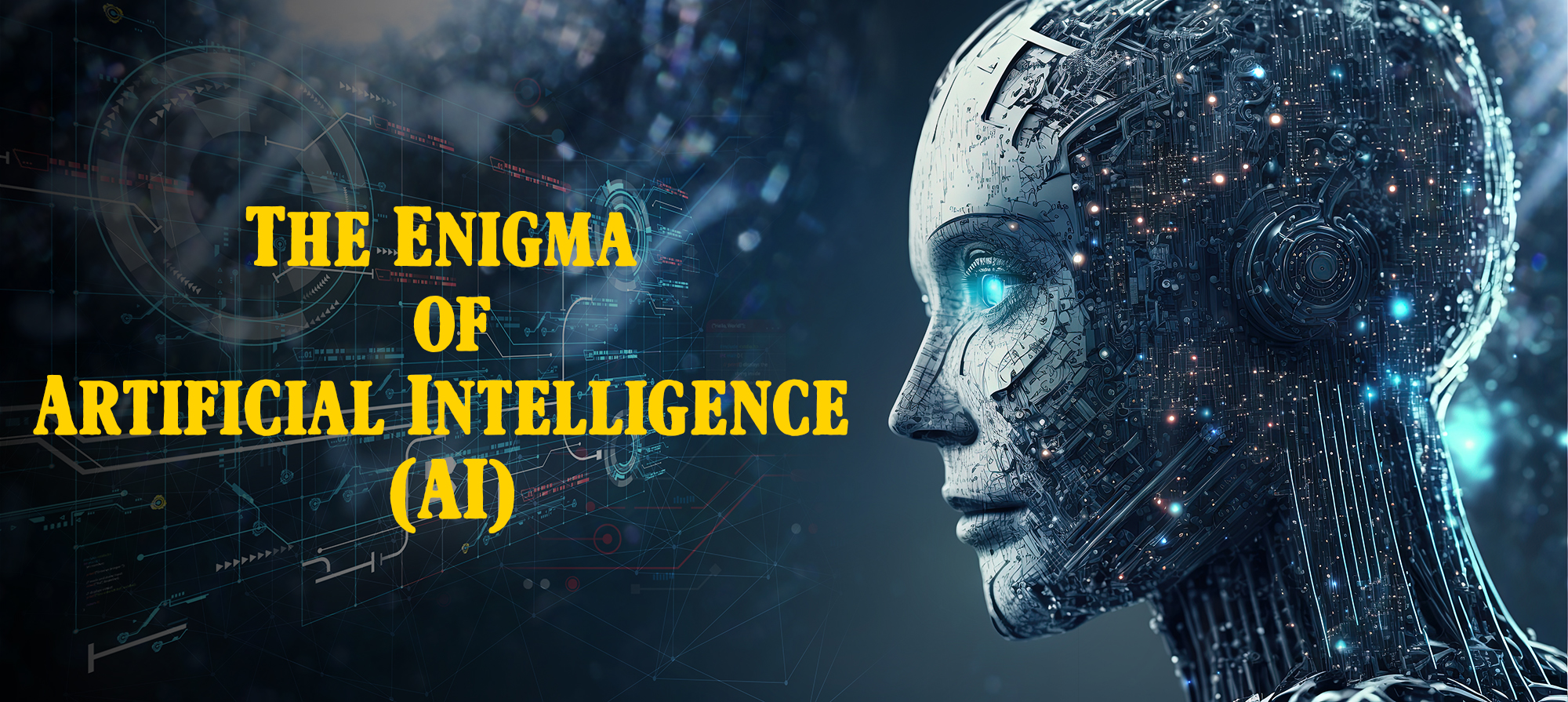
The Enigma of AI

The Enigma of AI
The modern era is an era of technology where the latest and varied changes have transformed the ways of living for humans.

The current technological sensation is Artificial Intelligence. Artificial intelligence is usually a method, tool and path which is more used than understood. There are above 1500 search engines in this world but whenever anyone wants to search anything, a common term is used which is “Google it”.

Likewise with AI, there are daily advancements, modifications, and improvements going on. But people connect AI with ChatGPT only.

Chat AI Overview
ChatGPT is a conversational AI chatbot developed by OpenAI that uses large language models to generate human-like text, engage in conversations, and perform various language-based tasks. It can answer questions, write different kinds of content, translate languages, summarize text, and even assist with coding.

Generative AI:
ChatGPT is a type of generative AI, meaning it can create new content based on the data it has been trained on.

Large Language Models:
It’s built on large language models (LLMs) that have been trained on vast amounts of text data, allowing it to understand and generate human-quality text.

Conversational Interface:
Users interact with ChatGPT through a conversational interface, sending prompts (questions, requests, etc.) and receiving responses.

Multimodal Capabilities:
While primarily known for text generation, ChatGPT can also handle audio and image inputs and outputs, and some versions can even generate images and videos.

Wide Range of Applications:
ChatGPT can be used for a variety of tasks, including:
• Answering questions: Providing information, explanations, and summaries.
• Writing content: Generating articles, stories, poems, scripts, and more.
• Code generation and debugging: Assisting with coding tasks, including writing code, explaining code, and identifying errors.
• Translation: Converting text from one language to another.
• Summarization: Condensing large amounts of text into shorter summaries.
• Brainstorming ideas: Helping with creative tasks and problem-solving.
• Simulating conversations: Engaging in interactive dialogues.

User Interaction:
Users can interact with ChatGPT through a chat interface, sending prompts and receiving responses. They can also provide feedback on the responses, which helps the model learn and improve.

Accessibility:
ChatGPT is available through a web interface and mobile apps, making it accessible to a wide range of users.

It is surprising to see that a platform has changed the overall mindset, availability of information, and connections of life. With so many qualities, now AI is the talk of the town but currently no one is looking at the real concerning areas behind it.

The biggest enigma of AI is that this platform has been opened to 8.2 billion humans of the world without giving them any proper introduction, details about AI fundamentals, and also the process of AI.

People are only interested in the surface outcomes of AI and this is causing over-reliance. Then, the problem is that this over-reliance can be mental, psychological, and conceptual. All these factors are currently evolving but are not observed by pertinent people.

Further, the validity of the information is the concern. The output provided by AI can be evaluated only if the prompt giver has information. But in the majority of the cases, people enquire about things which they don’t know and then use the output from AI as it is.

It is predicted that a strong flow of miscommunication and false communication and information is coming which will be accepted as valid and reliable. This will create enormous problems amongst humans and will hurt them in several ways.

Further, this information can also mislead humans in the development of their behaviors and attitudes and can cause distress, mistrust, and false deception of the relationships. It is concluded that AI is a beneficial element yet it needs proper guidelines, training, and information for betterment.

AI and the Gulf: How the GCC Is Shaping the Future of Artificial Intelligence

Artificial Intelligence is no longer a futuristic vision it is changing how we live, work, and govern. From revolutionizing healthcare to powering smart cities and global R&D, AI is accelerating breakthroughs across focus sectors. GCC countries are recognizing this seismic shift and positioning themselves at the forefront of AI innovation, driven by national visions, investment in talent, and strategic institutions.

United Arab Emirates: A Visionary Leader
In 2017, the UAE became the first country to appoint a Minister of State for Artificial Intelligence, kicking off its AI Strategy 2031 to establish global dominance in AI across healthcare, education, energy, transport, and government services.

The capital, Abu Dhabi, has unveiled a $13 billion government digital strategy (2025–2027) to automate public services and build massive cloud and AI infrastructure.

In 2020, UAE opened Mohamed bin Zayed University of Artificial Intelligence (MBZUAI) the world’s first graduate AI university. MBZUAI now offers undergraduate, master’s, PhD, and Executive Programs, collaborating with UNDP to support sustainable development across sectors.

Abu Dhabi’s Technology Innovation Institute (TII) under the Advanced Technology Research Council focuses on quantum computing, cryptography, robotics, and advanced LLMs (e.g., Falcon and Noor) for national and global application.

MBZUAI recently unveiled PAN (an AI world model) and large-scale LLMs like Jais and K2, along with launching a research hub in Silicon Valley, linking global expertise to the UAE’s AI ecosystem.

In May 2025, high-profile US–UAE tech partnerships worth over $200 billion were announced, including data center infrastructure agreements and talent initiatives supported by G42 and Mubadala.

Saudi Arabia: Building an AI Powerhouse
Saudi Arabia’s National Strategy for Data & AI (NSDAI) targets becoming a top 15 AI nation by 2030. The Saudi Data and AI Authority (SDAIA), established in 2019, leads the charge in data governance and AI coordination.

In May 2025, the kingdom launched Humain, an AI enterprise under the Public Investment Fund (PIF), focused on building Arabic multimodal LLMs, data centers, and AI infrastructure, backed by partnerships with NVIDIA, AMD, Qualcomm, AWS, and more.

Saudi Arabia also champions regional digital cooperation through the Digital Cooperation Organization (DCO), headquartered in Riyadh and including Bahrain, Kuwait, Oman, and Qatar advancing digital prosperity and AI governance frameworks.

Qatar: Arabic AI & Sustainable Innovation
Qatar has aligned its AI strategy with National Vision 2030, partnering with MIT and supporting the Qatar Computing Research Institute (QCRI) for Arabic-language AI, sports analytics, and energy sector applications.

QCRI’s Fanar platform provides advanced Arabic-centric multimodal LLMs, Arabic speech/image generation, and domain-adapted systems for Islamic and recency-aware applications.

Bahrain, Kuwait & Oman: Structured Growth and Better Governance
Bahrain established AI procurement guidelines in 2019 to promote responsible adoption across government agencies, embedding ethical, transparent frameworks.
Kuwait is actively developing legal and regulatory structures to govern AI, emphasizing cybersecurity, privacy, and harmonization with international AI norms.
Oman has integrated AI within its Vision 2040, expanding its digital and cloud infrastructure in collaboration with Microsoft and Google Cloud, focusing on public services and economic diversification.

Regional Overview: Governance, Talent & Economic Potential
A recent comparative analysis highlights a “soft regulation” style across GCC: flexible national strategies emphasizing innovation and ethics, but with ongoing concerns around enforceability and oversight.

GCC countries are investing heavily in talent development: Saudi Arabia’s “One Million Saudis in AI”, and the UAE’s National Program for Coders and golden visa for technology professionals to attract global expertise.

According to McKinsey, generative AI alone could deliver $21 billion–$35 billion annually to GCC economies, equating to 1.7–2.8% of non-oil GDP.

Looking Ahead: GCC’s AI Future Vision
The UAE aims to contribute by 2030 an estimated 13.6% of GDP ($96 billion) through AI, anchored by infrastructure, global talent centers (MBZUAI, Silicon Valley hub), and AI integration in governance.

Saudi Arabia is leveraging Humain, SDAIA, PIF investment, and DCO collaborations to establish itself as an AI export economy and smart infrastructure leader.

Qatar seeks leadership in Arabic-language AI and knowledge-driven sustainable development, while Bahrain, Kuwait, and Oman focus on scaling digital governance, regulation, and citizen services.

The GCC’s ambition to become an AI hub is no longer aspirational it is well underway. With robust national strategies, cutting-edge institutions like MBZUAI, SDAIA, TII, DCO, and strategic AI companies such as Humain, the region is rapidly building capacity to transform public services, diversify economies, and lead ethically within the global AI ecosystem.

By 2030–2031, the GCC aims not just to adopt AI, but to export AI innovation globally shaping the future of technology, human capital, and governance from within the Gulf.